Explore our specialized services, tailored solutions, and industry expertise to elevate your digital presence. From custom WordPress development to seamless integrations, we build high-performing websites that deliver impact.
Schema markup doesn’t get AI to cite your content, not on its own. That’s the most common myth in AI optimization right now, and it’s sending businesses’ time and budget in the wrong direction.
Schema markup for AI has become a popular talking point as businesses chase visibility in AI Overviews, ChatGPT, Gemini, and other AI-powered search experiences. The assumption is simple: add structured data, improve AI visibility. Real websites tell a different story.
Some pages with excellent schema markup never appear in AI-generated answers. Others earn citations with relatively basic structured data because the content itself is original, well-organized, and genuinely useful. Schema matters, but not for the reason most people think.
The Myth Behind Schema Markup for AI Optimization
Schema tells AI what your content is. It doesn’t tell AI your content deserves attention. That gap is exactly what the “just add schema” myth ignores.
The rise of AI search created demand for quick solutions, and agencies responded with checklists, plugins, and technical fixes. Schema markup became the headline recommendation because it’s measurable, easy to implement, and sounds like exactly what AI systems would reward.
Imagine two articles covering the same topic. One includes original research, practical examples, industry statistics, and expert insights based on real experience. The other summarizes information already published on dozens of websites. If both pages use identical schema markup, AI systems still have every reason to reference the stronger resource.
What Research Says About AI Search Visibility
Ahrefs tracked 1,885 pages after schema was added and found little evidence that structured data alone increased AI citations. That’s the clearest data point against the “just add schema” theory, straight from a sample size that’s hard to argue with.
The other major piece of evidence comes from the original Generative Engine Optimization study, run by researchers at Princeton and Georgia Tech, which tested which content characteristics actually improved visibility in AI-generated search results. Original statistics, citations, quotations, and unique information consistently outperformed generic content. Schema wasn’t even part of the experiment.
Neither study suggests schema is unnecessary. Instead, they point to a more realistic conclusion: high-quality content earns attention first, and schema helps AI systems understand that content more efficiently.
What Schema Does for AI Search
Schema markup is a translation layer. It tells an AI crawler exactly what a page represents, instead of leaving it to guess whether the page is a company, a product, an article, or an event.
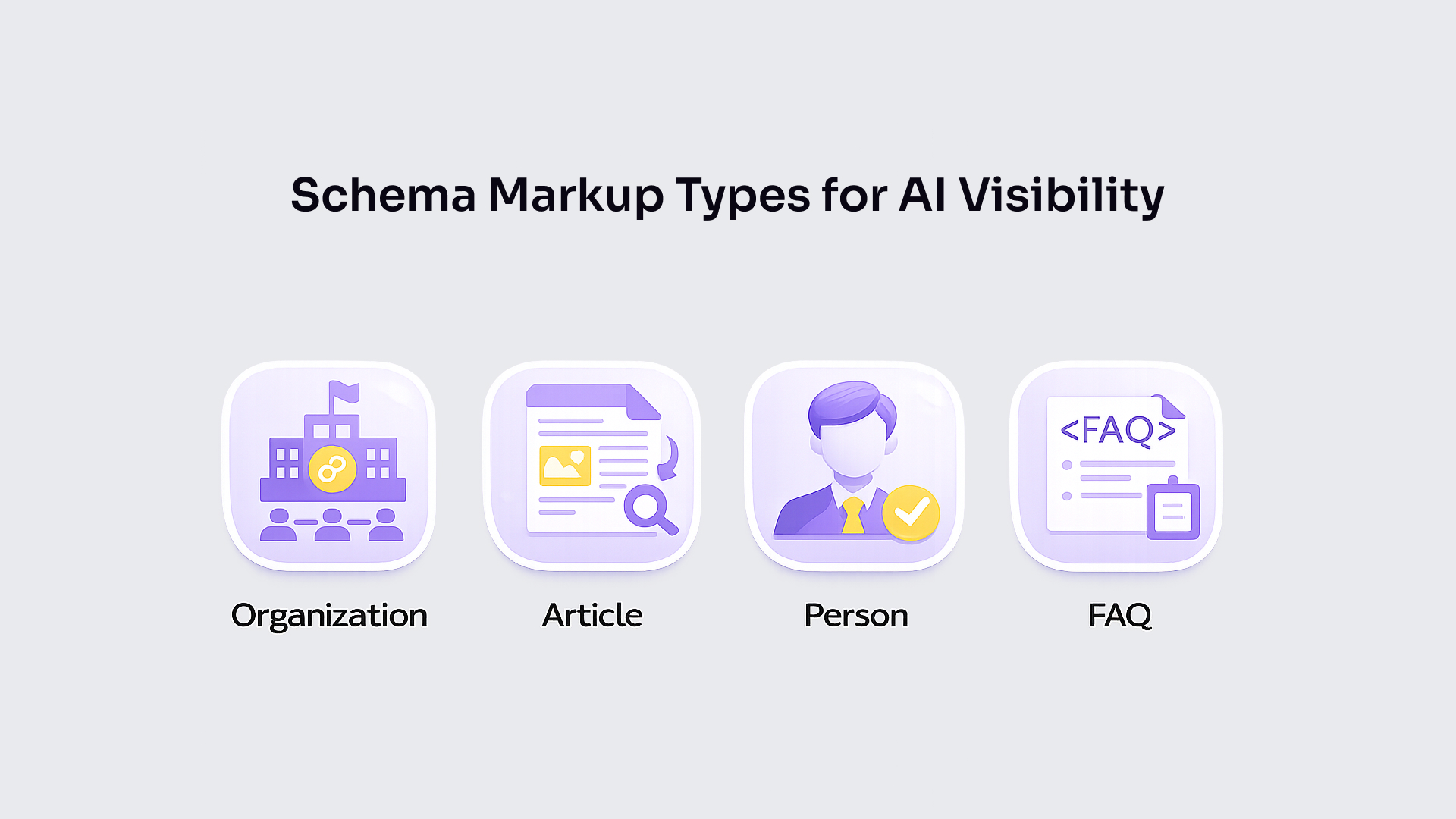
Organization schema identifies a business.
Article schema explains the content type, author, and publication details.
Person schema connects content to real experts.
FAQ schema separates questions from answers instead of leaving AI systems to infer the relationship from headings alone.
This is where structured data and schema markup for AI search become valuable. AI models process enormous amounts of information, and the fewer assumptions they need to make, the easier it becomes to understand the entities, relationships, and context behind a page. Humans can pull meaning from context. Machines prefer explicit signals.
Which Schema Types Matter Most for AI
Four schema types matter most for the majority of business websites: Organization, Article, Person, and FAQ. Everything past that is situational.
Organization schema establishes brand identity and connects the website to logos, social profiles, and other recognized entities.
Article schema provides clear information about headlines, publication dates, modifications, authors, and publishers, details that matter more as AI search engines lean harder on freshness and credibility.
Person schema associates content with real authors instead of anonymous pages, and expertise matters most for technical and professional topics.
FAQ schema works well when a page genuinely answers common questions. Artificial FAQ sections built purely to generate markup rarely help users or AI systems.
Product, Service, LocalBusiness, Event, or Review schema may also make sense depending on the website. The goal isn’t to implement every available schema type. It’s describing the page accurately.
Schema Is an Amplifier, Not a Shortcut
Schema can’t make weak content authoritative. That’s the simplest way to understand schema markup optimization for AI platforms.
Picture a research report filled with original data, expert commentary, and practical recommendations. Now picture the same report without headings, author information, dates, or a clear structure. The information is still valuable, just harder to interpret. Schema fixes that.
Now reverse the example. Take a generic article with recycled advice and little original thinking, and add perfectly structured data. Nothing meaningful has changed.
This pattern shows up repeatedly during technical content audits. Websites with comprehensive schema often struggle to earn visibility because the information offers little AI systems haven’t already seen elsewhere. Meanwhile, pages with useful insights, clear structure, and credible sources keep appearing in AI-generated responses even with relatively simple markup.
Best Practices for Schema Markup in AI Search
Effective schema markup starts with accuracy, not volume. Five practices separate implementations that actually work from ones that don’t:
Use JSON-LD whenever possible, and make sure structured data reflects the visible content on the page. If the markup describes information users can’t actually see, trust starts to erode.
Choose schema types that genuinely match the page, instead of adding every available option.
Include properties like authors, publication dates, modification dates, organizations, products, services, and entity relationships whenever they’re relevant.
Validate structured data regularly. Schema errors tend to appear after CMS updates, plugin changes, or template changes.
Build on pages that already work. The strongest schema markup for AI search visibility supports content that already delivers expert insights, original information, and clear answers to real questions.
Schema and AI Overviews
What schema markup is needed for AI Overviews? There isn’t one answer, because AI Overviews don’t rely on a single type of structured data.
Google’s AI systems combine information from multiple sources while evaluating quality, expertise, and relevance. Schema helps identify entities, organizations, authors, products, FAQs, and relationships across a page. That’s useful. It isn’t a guarantee.
A page with perfect schema but generic content is still competing against resources with original research, practical expertise, credible sources, and information users can’t easily find elsewhere.
Common Schema Mistakes
Six mistakes account for most of the schema problems we find during audits:
Structured data generated automatically without verifying it actually matches the page.
Incomplete author information that provides no evidence of expertise.
Conflicting schema types describing the same content in different ways.
Outdated publication dates.
Review markup for testimonials that don’t exist.
Weeks spent refining structured data while the content itself never gets touched.
Technical optimization can’t compensate for articles that lack original insights, useful examples, or clear expertise. Schema should reinforce quality, not try to replace it.
AI Tools Can Generate Schema. They Can’t Build Authority
Plugins, online generators, and AI assistants make structured data fast to produce, which is a genuine advantage. But they don’t know which case study best demonstrates expertise, can’t identify the original insight buried inside years of client work, and won’t recognize where supporting statistics strengthen an argument or where a claim still needs evidence. Those decisions still require strategy.
At IT Monks, schema implementation is never treated as an isolated task. Content quality, entity relationships, information architecture, internal linking, and technical performance get evaluated first. Structured data then reinforces those signals so AI search engines can interpret them with more confidence.







 ChatGPT
  Claude
  Grok
Grok  Gemini