Digital Web Strategy

Table of Contents
Digital web strategy outlines how website decisions are made before execution and how those decisions translate into measurable outcomes through WordPress website development. It operates as the decision-and-planning layer that governs site structure, pages, internal linking, tracking, and performance constraints, with WordPress serving as the delivery environment where strategy is implemented, tested, and validated.
At an execution level, digital web strategy translates intent into action by defining a primary conversion goal, establishing measurement criteria to evaluate success, aligning individual pages to user intent, and optimizing key pages for conversion efficiency. It then organizes those pages into a coherent conversion path, applies funnel tracking to observe user progression, identifies drop-off points, and guides iterative improvements based on performance data.
What is Digital Web Strategy?
Digital web strategy is a website-first plan that governs how business objectives are translated into measurable online outcomes through a website’s structure and behavior. It defines the primary conversion action, maps user intent and audience segments, structures site architecture and key pages, aligns conversion paths with funnel tracking, specifies measurement parameters such as KPIs and events, and enforces performance constraints, including load speed and page responsiveness. While it is executed through website development workflows, it is not defined by any CMS or toolset.
A digital web strategy aligns business goals with user journeys by prioritizing page-level intent, internal linking, and clear pathways from entry points to conversion endpoints. It includes a structured measurement system that tracks user behavior, such as bounce rate, event completion, and drop-off points, and uses this data to iteratively improve both user experience and performance over time.
The scope of digital web strategy explicitly excludes broader channel marketing, brand-only positioning initiatives, and non-measurable digital presence activities.
The digital web strategy is implemented through WordPress website development, where design, functionality, content, and analytics are integrated to turn defined strategic decisions into a working, optimized site.
How Digital Web Strategy Works?
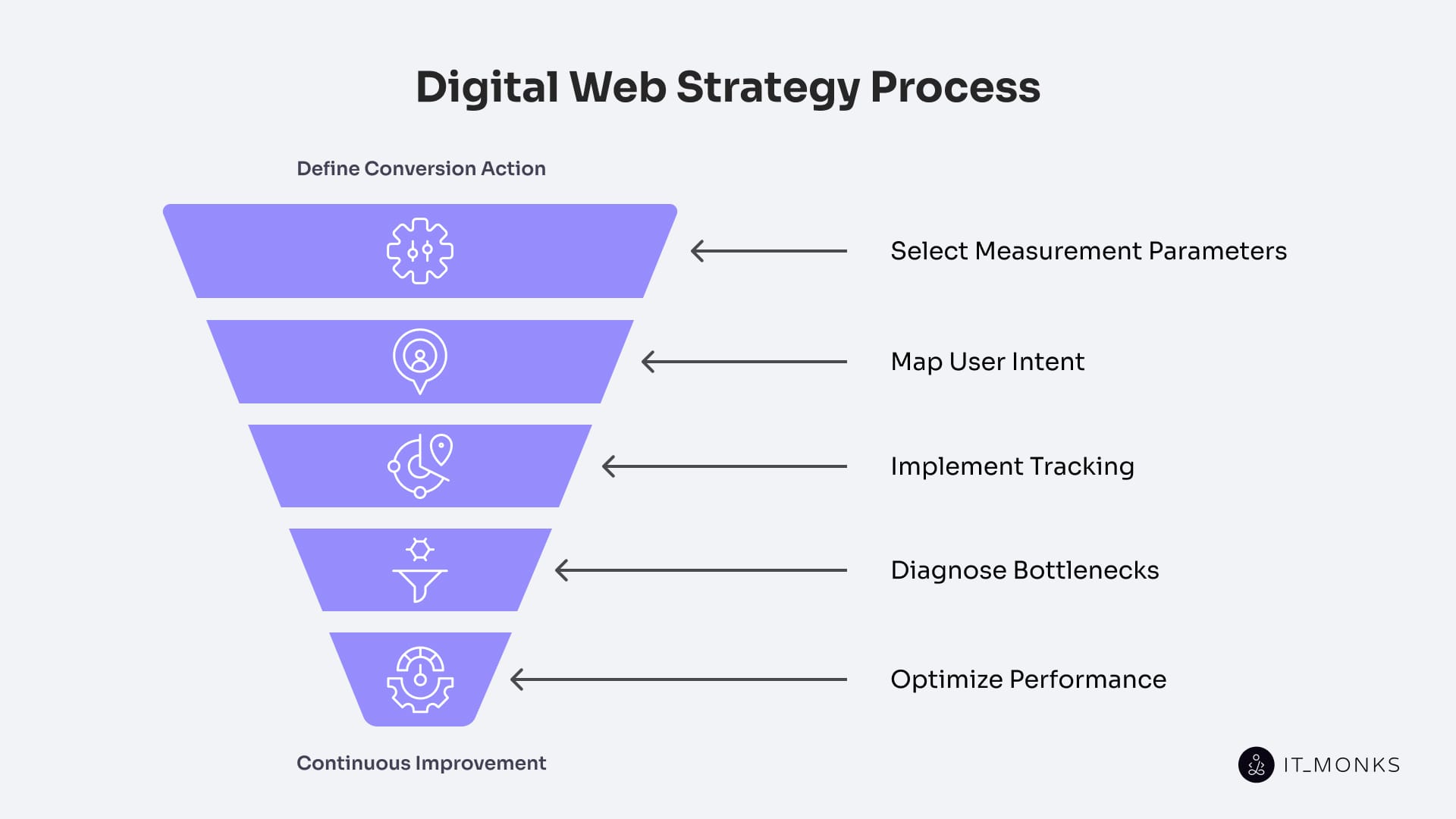
Digital web strategy operates as a repeatable system that converts a business objective into structured website decisions, measurable behavior, and continuous improvement within WordPress website development. It begins by defining a primary conversion action, because every page, funnel step, and optimization effort must reference one observable success outcome.
Measurement parameters, KPIs and events, are then defined so performance is evaluated against a baseline rather than assumed. User intent and audience segments are mapped to a page system and site architecture, ensuring each page has a clear role and intent fit before optimization begins.
Key pages are prioritized and linked into a conversion path because pages only create value when they guide users toward the conversion action through a controlled funnel. Tracking is implemented across that path to measure step completion and drop-off, making user behavior observable.
The system then identifies the largest drop-off point and applies targeted optimization to reduce friction, clarify decisions, and improve completion metrics. Performance constraints, such as load time measured in seconds or milliseconds, are optimized so speed and stability do not limit conversions already enabled by intent, structure, and optimization.
Digital web strategy closes the loop through iteration by measuring outcomes, learning from KPI movement, adjusting pages or paths, and re-measuring.
Why is a Digital Web Strategy Important?
A digital web strategy is important because it makes website outcomes predictable, measurable, and controllable throughout WordPress development. Aligning the site with a single business objective and primary conversion action prevents scattered decisions and clearly defines what the website is built to achieve.
It establishes measurement parameters early by defining KPIs, analytics events, and goals, creating accountability and a baseline for validating progress rather than assuming success. At the same time, it reduces user-intent mismatch by ensuring that pages reflect clear intent, improving conversion clarity and lowering friction across the site.
Digital web strategy then organizes key pages into a defined conversion path and applies funnel tracking to identify drop-off points and bottlenecks in conversion. Optimization is guided by impact, prioritizing changes at the highest-loss points and protecting gains through performance improvements such as page speed and load-time reliability.
Digital Web Strategy Best Practices
Set the Primary Conversion Action
The primary conversion action is the single, clearly observable macro-conversion (such as a completed purchase, submitted lead form, booked consultation, or account signup) that represents the website’s successful fulfillment of its core business objective and anchors all decisions in WordPress website development.
Defining the primary conversion action establishes a clear goal hierarchy by distinguishing the macro-conversion from supporting micro-actions. Clicks, scrolls, and intermediate interactions remain assist signals rather than competing goals, preserving attribution clarity.
The primary conversion action must map to specific key pages where completion occurs, with a clearly defined CTA placed within the relevant page template, form, checkout, or booking flow that generates a measurable conversion event. Selection is constrained by intent fit, business value, measurability, and feasibility within the current WordPress experience, because pages, funnel steps, and tracking only function when success is expressed as a rate (%) or a count tied to one outcome.
Defining the primary conversion action first constrains friction analysis, completion measurement, and drop-off diagnostics to a single success signal. All subsequent practices (measurement parameters, intent-matched pages, key-page optimization, conversion-path linking, funnel tracking, drop-off fixes, and performance improvements) are meaningful only when measured against the same conversion goal, such as structured lead generation on a WordPress site.
Set the Measurement Parameters
Measurement parameters define how the primary conversion action is proven, monitored, and validated throughout WordPress website development. They are anchored in a single primary KPI, typically a conversion rate (%) or completion rate (%), that directly represents the conversion outcome.
Supporting KPIs explain movement in the primary metric through step completion %, click-through %, error rate %, and performance indicators such as load time measured in seconds or milliseconds. Measurement parameters also define the conversion event and supporting events required to compute each KPI, maintaining consistent event definitions so attribution remains stable across pages and funnel steps.
Segmentation rules, reporting scope, and a fixed baseline or benchmark are specified so that change can be evaluated against a known state rather than relying on intuition. Review cadence is defined to ensure optimization follows observed variance, while data quality validation remains part of the measurement workflow.
Measurement parameters depend on a clearly defined primary conversion action, because intent-matched pages, key-page optimization, conversion paths, funnel tracking, and drop-off analysis only operate correctly when success and failure are observable through consistent KPIs and events within a unified web analytics framework.
Create Pages that Match User Intent
User intent constrains which pages exist, the role each page performs, and how each page contributes to the primary conversion action. Dominant intent types relevant to the conversion goal must be identified and mapped to specific page roles so every page serves one clear, non-overlapping purpose within the conversion system.
Each page is constrained to a single primary intent, with CTA alignment and information hierarchy structured to match user expectations at that stage. Page performance is validated by assigning a measurable success signal, an event or KPI contribution, that confirms the page is fulfilling its intended role rather than generating undefined engagement.
Intent-matched pages must be reachable through internal linking and navigation that surface them within the site structure and preserve progression toward conversion. Intent fit is a prerequisite for optimization, because conversion optimization cannot correct pages that attract the wrong audience. Only intent-aligned pages can support reliable conversion-path linking, funnel tracking, and drop-off analysis against defined KPIs. This page system keeps content decisions subordinate to conversion measurement, rather than allowing scope drift into a disconnected digital content strategy.
Optimize Key Pages for Conversions
Key page conversion optimization improves measurable completion of the primary conversion action on pages that control funnel progression within WordPress website development. These key pages include entry pages that attract intent-aligned traffic, decision pages that resolve uncertainty, and conversion pages where the conversion event is completed and counted in the primary KPI.
Key pages must be intent-validated before optimization, because conversion optimization cannot correct pages that attract the wrong audience. Each key page is constrained to a single conversion action and CTA with explicit placement and wording, ensuring the CTA triggers the intended event and supports conversion rate % rather than competing micro-actions.
Optimization focuses on removing friction that blocks completion by simplifying step flow, reducing form burden, and eliminating unnecessary steps to improve form completion % and step completion %. Decision clarity is reinforced through content hierarchy, information scent, and credibility cues, thereby reducing drop-off risk.
Key pages must provide one explicit next step via internal linking to maintain measurable funnel progression, and must operate within defined performance limits, including load time measured in seconds or milliseconds, because latency reduces completion even when intent and CTA alignment are correct.
All changes are validated against defined measurement parameters by tracking the conversion event, monitoring conversion rate %, and reviewing supporting completion and interaction metrics. Optimization is considered successful only when a specific page change results in a measurable improvement in a KPI, as outlined in our CRO guide.
Link Pages Into a Conversion Path
A conversion path is an ordered sequence of pages that guides users from intent entry to the primary conversion action through constrained, measurable funnel steps. Conversion path mapping starts by identifying step pages, then assigning roles (entry → evaluation → decision → conversion) so each page knows its “next step” destination and avoids branching unless segmentation requires a controlled split.
Conversion paths use internal links, navigation, and in-page CTAs as routing surfaces, and conversion path consistency requires a single clear next action per page to prevent loops, dead ends, or competing destinations that dilute step-completion signals. Conversion path measurement alignment requires an observable event per step and a step-completion metric expressed as % or count, so the path can be validated as progression rather than assumed flow.
Conversion path design depends on the primary conversion action and key pages, as the path exists to route intent-matched traffic toward a measurable outcome. Once the path is stable, funnel tracking can mirror it and quantify drop-offs step by step.
Customer experience optimization should remain subordinated to this path logic by reducing friction and preserving intent continuity at each handoff, rather than adding unrelated journeys that compete with the primary conversion goal.
Implement Funnel Tracking
Funnel tracking makes the conversion path observable by recording events for each funnel step and comparing step-by-step completion within WordPress website development. It is constrained by a defined conversion path, a single primary conversion event, and explicit step events that represent progression across entry, evaluation, decision, and conversion pages.
Funnel tracking depends on consistent event naming and minimal, stable event properties, so step mapping remains accurate across pages and sessions. Data integrity validation is required to ensure events fire once per intended action and map to the correct page–step relationship, preserving attribution clarity.
Funnel outputs include step completion % and drop-off % for the defined segment and reporting window, exposing the largest loss point and tying performance back to the KPI baseline and measurement parameters. Multiple primary conversion goals must not coexist in the same funnel, because attribution and optimization decisions remain testable only when success is defined by a single outcome.
Funnel insights become actionable when interpretation stays grounded in measured events rather than assumptions. Disciplined user behaviour analysis can support step-level diagnosis after the weakest step is identified, without shifting or expanding the core conversion goal.
Fix the Biggest Drop-Off Point
Fixing the biggest drop-off point means targeting the funnel step with the highest drop-off % or lowest step completion %, confirmed over a defined segment and reporting window. “Biggest” is a measured property of a specific step, not a subjective judgment, and selection depends entirely on validated funnel tracking data.
Diagnosis begins by verifying event integrity, then isolating the failing step page and step event. The likely cause is classified based on observed behavior patterns, including intent mismatch, friction in forms or steps, unclear CTA or next action, trust gaps, technical errors, or performance latency. Only one step is addressed at a time, because changing multiple steps breaks attribution and obscures the true source of improvement or regression.
Fixes prioritize the smallest targeted change that can move the step metric. Validation requires re-measuring the same KPIs and step events, comparing before-and-after values in percentages and counts, and confirming that improved step completion lifts downstream conversion performance.
Visual diagnostics remain subordinate to measured step selection. Tools such as heat maps, which we discussed in detail in our heat map guide, support friction classification only used after the weakest step is confirmed by data, ensuring visual insights explain measured loss rather than replace it.
Improve Performance
Performance improvements reduce measurable delay and instability on key pages, so conversion steps complete reliably within WordPress website development constraints. Prioritization targets the key pages and funnel steps with the largest measured drop-off, because performance gains on low-impact pages rarely move the conversion rate or step completion.
Performance measurement defines unit-safe speed and stability metrics (load time in seconds or milliseconds, interaction responsiveness, layout stability, and error rate) and establishes baselines and benchmarks so changes can be validated against the same measurement parameters. Performance fixes address category-level bottlenecks, such as payload size, render delay, server response time, caching behavior, and asset delivery, with each change validated through event data and KPI movement rather than on assumed benefits.
Validation requires re-measuring step completion % and drop-off % after each change to confirm that reduced latency or instability improved funnel progression. Performance work remains iterative to prevent regressions that reintroduce friction. When measured consistently, performance acts as a conversion multiplier by reducing abandonment and protecting conversion gains across the entire conversion path.


Contact
Don't like forms?
Shoot us an email at [email protected]