Progressive Enhancement in WordPress Design

Table of Contents
A WordPress website adopting progressive enhancement establishes a layered rendering model that supports consistent delivery across devices, web browsers, and varying render capabilities.
The enhancement strategy sets semantic HTML as the baseline experience, applies CSS for presentation, and adds JavaScript only when the render context enables it, thereby preserving fault tolerance, supporting device independence, and maintaining stable, capability-based rendering.
In WordPress website development, progressive enhancement supports a baseline output, separates core markup from higher layers, and exposes a semantic structure that defines the baseline experience, providing fallback behavior when higher layers fail. This structure enables the WordPress theme to deliver consistent, capability-aligned output across environments.
In this architecture, the progressive enhancement strategy responds to environmental variability, enhances accessibility compliance, and delivers a responsive baseline through ordered enhancement layers of HTML, CSS, and JavaScript.
What is Progressive Enhancement?
Progressive enhancement is a development strategy that builds a WordPress website from a baseline and then extends it with enhancement layers that respond to browser and device capabilities.
Within a WordPress theme, progressive enhancement starts with semantic HTML to render core information, separates presentation into CSS, and relies on optional JavaScript to improve the user experience when capability detection confirms available features.
With this foundation established, the layered model preserves accessibility and device independence, ensures structural markup renders when network conditions or scripts fail, provides fallback behavior, and degrades gracefully when unsupported features are encountered.
Building on that logic, the HTML/CSS/JS layers operate as a progressive model that enables resilience to failures, maintains SEO-relevant semantics, and stabilizes front-end rendering across diverse clients.
What Are the Structural Layers in a Progressive WordPress Theme?
A progressive WordPress theme is structured in layered stages that separate content, presentation, and behavior, creating the front-end architecture required for progressive enhancement.
The content layer is formed when a WordPress theme delivers semantic HTML through theme templates. This layer defines the DOM, ensures accessible structure, and provides the fallback-safe baseline for progressive rendering and consistent frontend output.
From this baseline, the theme extends into the presentation layer, refining how the content is visually rendered.
The presentation layer is applied when stylesheets enhance the HTML and structure the visual interface. CSS is loaded from style.css, additional enqueued stylesheets, and block styles, which build layout systems while preserving fault tolerance, allowing content to remain accessible if styles fail to load.
Beyond visual formatting, the theme extends into the behavior layer, which handles optional interactivity.
The behavior layer emerges when JavaScript (JS) introduces optional interactivity without blocking access to content. Through script enqueueing, block-level scripts defined in block metadata, and capability-sensitive loading, JS performs capability detection, augments the DOM, and progressively enhances components while maintaining fallback guarantees of the HTML layer.
Which Technology Principles Enable Progressive Enhancement in WordPress?
Progressive enhancement in a WordPress theme is enabled by principles that define how content, styles, and scripts render across environments.
The baseline layer is established through semantic HTML, which provides core content structure. WordPress template files output <header>, <main>, <article>, and similar elements, forming a readable markup hierarchy and an accessibility layer independent of CSS or JavaScript.
On top of this structural layer, separation of concerns keeps HTML, the CSS layer (style files and visual cascade), and JavaScript enqueues independent, so each enhancement layer can fail without affecting server-rendered content.
Because layers are independent, graceful degradation maintains functionality when enhancements are unavailable. WordPress menus, forms, and pagination continue through standard HTML fallback behavior.
Feature detection uses browser capabilities to govern conditional loading. Scripts can be conditionally enqueued based on template or environment, and activated at runtime when browser APIs indicate support.
After capability evaluation, progressive disclosure limits initial payload by deferring comment threads, expandable menus, and dynamic components to the DOM readiness stage.
At the component level, a modular component structure isolates enhancement. Template parts, reusable blocks, and widget areas render baseline markup first and apply optional logic through conditional rendering.
Implementation of Progressive Enhancement in Themes
WordPress theme development transitions into the implementation phase and requires a layered implementation approach that structures content, presentation, and behavior to support progressive enhancement.
Theme development organizes these layers so that each enhancement step builds on a stable base, structuring markup, styles, and front-end logic within a framework that aligns with progressive enhancement.
This phase focuses on how layered rendering is applied within the theme to support reliable front-end logic and consistent behavior across environments, while laying the groundwork for applying development patterns and fault-tolerant techniques within the standard WordPress theme architecture.
How to Apply a Layered Approach in Theme Development?
Applying progressive enhancement in a WordPress theme requires strict layering, starting with theme templates that output semantic HTML in index.php, page.php, single.php, archive.php, and related files.
These templates define <main>, <header>, <nav>, <section>, and <article> to establish a content-first markup baseline and minimal fallback that remains usable without CSS or JavaScript.
The theme adds the presentation layer by enqueuing CSS in functions.php through wp_enqueue_style(). style.css provides the base cascade, and additional styles remain modular and external. The theme enqueues CSS files separately to enhance presentation without altering structure, preserving a stable style cascade if styles do not load.
The behavior layer loads JavaScript via wp_enqueue_script() only when required. These conditions must be defined in functions.php, not inside template files. The theme checks DOM capabilities and waits for DOM readiness events before executing UI logic.
Then it applies JavaScript conditionally through the enqueue queue to extend interaction while keeping the HTML layer functional when scripts are blocked.
The theme finalizes the stack with conditional and modular enhancements using is_singular(), has_block(), and similar checks to load assets only when needed. Non-critical scripts can be deferred, and selective loading maintains efficient, context-aware rendering.
This sequence ensures the theme remains functional at the HTML layer and progressively enhanced through CSS, JavaScript, and conditional loading, forming a fault-tolerant WordPress front-end.
What Are Best Practices for Building Fault-Tolerant Interfaces?
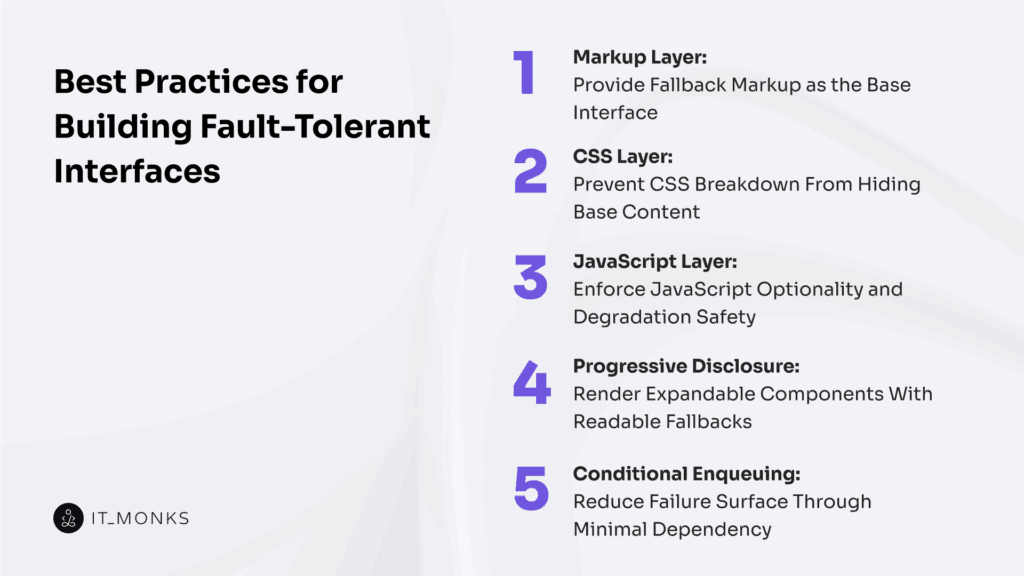
A WordPress theme establishes fault tolerance by using semantic HTML as fallback markup, preserving content accessibility when CSS or JavaScript fails. Template files render links, forms, and buttons as functional elements, so base navigation and submissions operate without scripting. The markup layer provides a semantic fallback structure that keeps content accessible in the event of stylesheet or script failure.
CSS rules avoid visibility loss by keeping essential content readable by default. Critical elements are not hidden behind display:none or hover-only states unless they remain visible without stylesheets. This prevents layout failure and maintains layout integrity during CSS breakdown.
JavaScript operates as an optional enhancement. Scripts are enqueued conditionally through template logic, run only after DOM readiness, and attach behavior only when target elements exist. If a script fails, base functionality persists, and interaction degradation is isolated from content access. <noscript> fallbacks preserve required interactions when JavaScript is unavailable.
Progressive disclosure components, such as tabs, accordions, modals, and sliders, render their content in the HTML as visible, readable sections. JavaScript applies collapsed or reorganized states only after successful execution, preventing interface breakdown when scripting does not run.
A theme uses conditional enqueuing and code splitting so that only template-specific assets load. Scoped assets isolate enhancement layers, support dependency handling, and reduce the impact of script failure or partial loads.
A WordPress theme enforces this model by separating base rendering from optional enhancement. Each layer can degrade independently while preserving access, ensuring stable rendering resilience under fluctuating CSS, JavaScript, or browser support conditions.
Design Models Supporting Progressive WordPress Enhancement
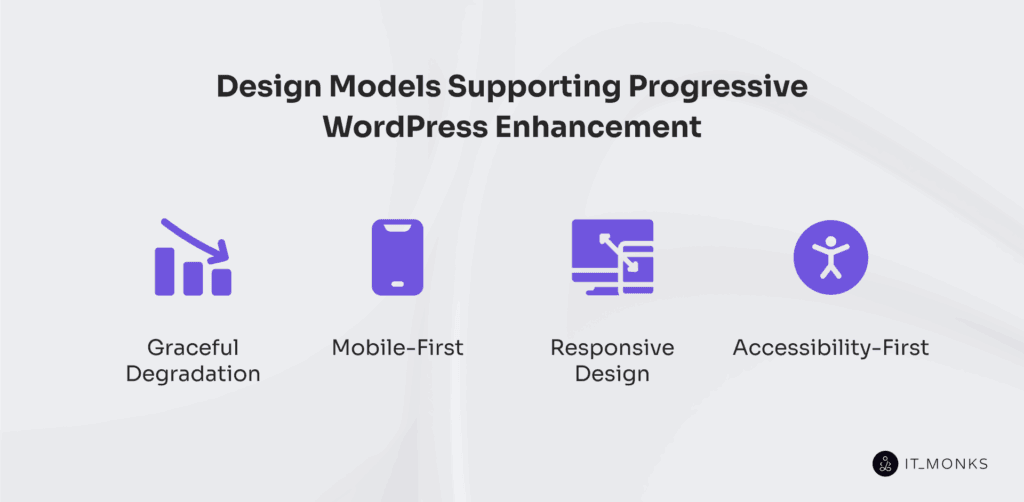
Design models supporting progressive enhancement establish complementary strategy layers that guide how a WordPress theme maintains reliable, device-agnostic behavior across changing conditions within a WordPress website.
As part of this strategic framework, these design models, such as graceful degradation, responsive design, mobile-first, and accessibility-first, align with and extend the layered structure used to deliver a progressively enhanced WordPress website by framing how scalable layouts, UI fallback structures, and accessibility constraints shape interface behavior and enhancement compatibility.
Building on this alignment, each model reinforces progressive enhancement by guiding scalable interface behavior and structural resilience, informing how a WordPress theme adapts to device variability, preserves accessibility, and sustains structural resilience.
Graceful Degradation
A WordPress theme maintains interface stability when higher-layer capabilities fail by applying Graceful Degradation within a progressive enhancement strategy. A WordPress website stays functional because template-level semantic structure provides markup fallback during styling loss or script failure, maintaining baseline accessibility and sustaining template resilience.
A theme ensures navigation, reading order, and core interactions work without CSS or JavaScript by isolating non-critical dependencies so their absence does not block content access.
By allowing each enhancement layer to fail safely, the WordPress theme supports overall interface resilience and reinforces progressive enhancement, ensuring the website degrades gracefully instead of breaking when advanced features fail.
Responsive Design
A WordPress theme applies responsive design as a presentation layer that adapts layout to viewport constraints while preserving the baseline of progressive enhancement. Using fluid grids, scalable elements, media queries, and CSS media handling, the theme’s styling responds to breakpoints without altering markup or core behavior.
From these conditions, the CSS rules scale spacing and typographic proportions through resolution-aware styling, ensuring device-specific styling modifies presentation only.
In this role, the theme uses responsive web design to support content structure and enhance layout delivery while keeping its semantic and functional architecture intact.
Mobile-First
A WordPress theme structures mobile-first styling in its style.css or modular stylesheet stack as a cascade that begins with base styles optimized for the mobile viewport under its initial viewport constraint, then builds upward through layered styling defined in media queries at higher-width breakpoints.
In this structure, these base rules form a universal base layer that scales from small-screen constraints. Because of this cascade order, larger-screen refinements are applied only when capability conditions are met, ensuring the style delivery hierarchy and cascade order maintain a functional mobile baseline even under partial failure.
As a result, this mobile-first CSS structure supports progressive enhancement by establishing a content-first, device-agnostic foundation before capability scaling occurs, allowing the WordPress theme to adapt styling predictably as viewports expand.
Accessibility-First
Accessibility-first in a progressive WordPress theme means the WordPress theme exposes an operable interface through template markup before styles or scripts load. A theme structures semantic HTML, landmark roles, heading sequences, and a logical tab order, giving screen-reader and keyboard access through structural markup alone.
Building on this baseline, template files render accessible navigation with consistent landmark roles and focus management patterns, which ensure compatibility with assistive technologies and preserve keyboard operability if stylesheets or scripts fail. From this stable foundation, the theme aligns with progressive enhancement by allowing visual and interactive layers to build on an already accessible interface.
Contact
Don't like forms?
Shoot us an email at [email protected]