Digital Content

Table of Contents
Digital content is any form of information created, structured, and distributed in digital formats to communicate meaning, deliver value, or enable interaction across digital environments. It is commonly classified by type (such as text, image, video, audio, interactive, and multimedia) because each format encodes information differently and imposes distinct production requirements.
Digital content is produced by individual digital content creators and content creation agencies, who plan and execute production using specialized creation tools. AI for content creation is a subset of these tools, supporting specific tasks like drafting, editing, and design without replacing the broader production process.
To ensure consistency and purpose, digital content is governed by a content strategy that sequences decisions from objective definition and KPIs to audience targeting, positioning, format selection, creation, and publishing. Publishing marks the completion of the content lifecycle, as only published content can be distributed, measured, and evaluated. At that point, digital marketing becomes the downstream context in which digital content is leveraged for performance outcomes.
What is Digital Content?
Digital content is any media encoded in a digital format and designed to be stored, accessed, rendered, transmitted, and duplicated via digital systems. It exists as data, typically structured as a file or media object, and relies on electronic storage rather than physical form, enabling retrieval, copying, and delivery across devices and networks.
Because digital content is encoded information, it depends on defined formats and metadata to control how it is rendered and handled, such as pixel dimensions for visual assets, duration for time-based media, or file size for storage and transfer.
Digital content also follows a publishing lifecycle in which it is created, prepared, published, and evaluated using metrics such as usage, reach, or performance signals. Within this scope, digital content includes materials intended to inform, educate, entertain, or enable interaction, while excluding physical-only materials that cannot be encoded, stored, or distributed digitally.
What are Digital Content Types?
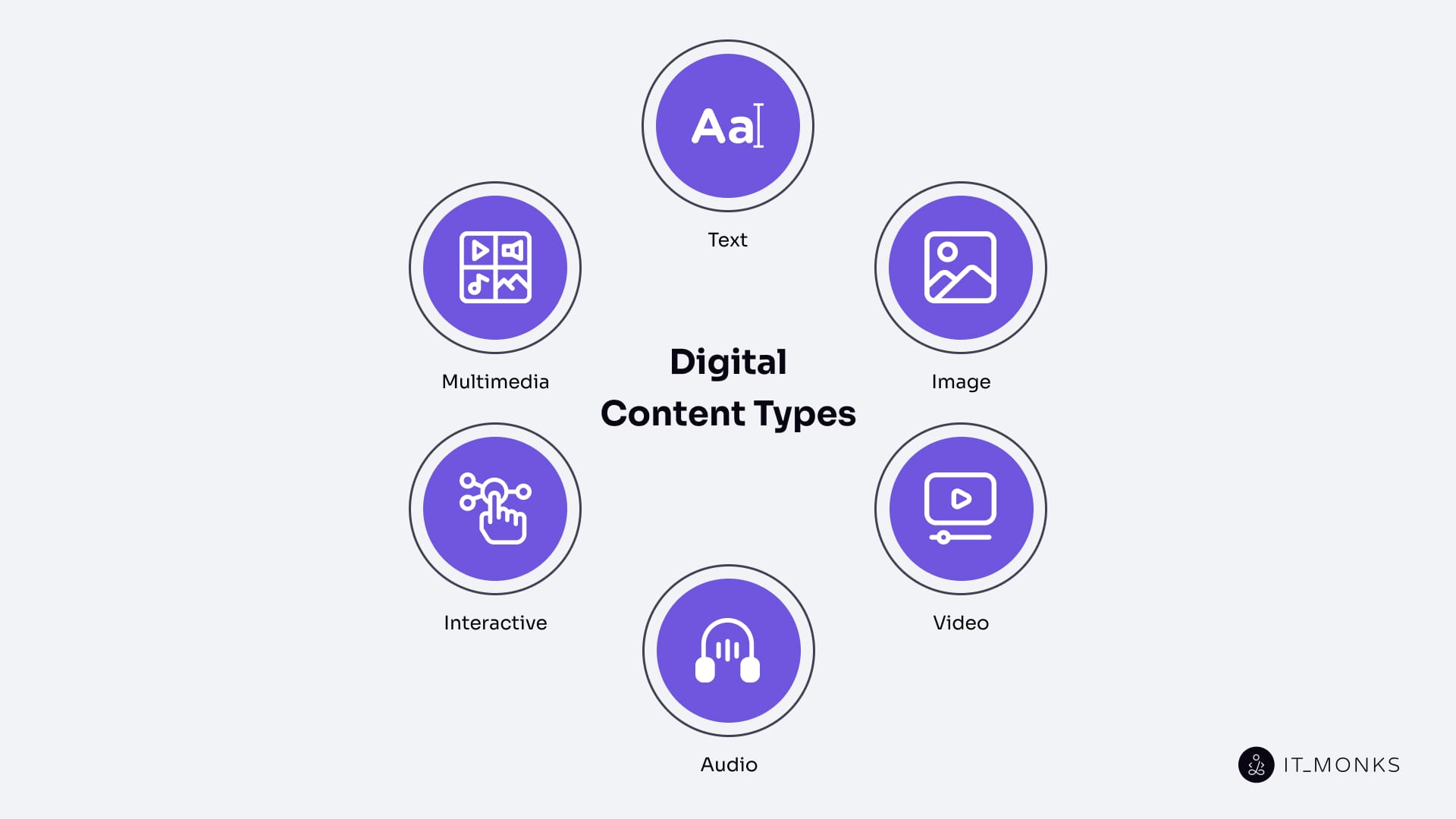
Text
Text content is any written information composed of characters, words, and sentences presented in digital or physical formats, such as website articles, blog posts, documents, and messaging. It is used to explain, guide, label, and clarify information through explicit statements and instructions. Common forms include headings, paragraphs, lists, captions, and interface labels.
Text content depends on formatting, tone, and length to maintain readability and screen scannability. It is most effective for precise explanation and is often supplemented by other content types when visual detail, motion, sound, or interaction is required.
Image
Image content communicates information through static visuals. It conveys shape, layout, and context at a glance and is used to illustrate or visually support a message. Image content includes photographs, graphics, illustrations, icons, screenshots, and diagrams. It is defined by properties such as pixel dimensions and file size, and requires sufficient resolution and a clear subject to remain legible. Captions and alt text are commonly used to clarify meaning and support accessibility.
Video
Video content delivers meaning through moving visuals over time, often combined with audio. It is suited for demonstrating actions, processes, and sequences that depend on motion or timing. Common formats include tutorials, product demos, explainers, animations, and screen recordings.
Video content is constrained by duration, resolution, file size, and playback performance. Captions or subtitles are frequently used to maintain accessibility and comprehension when audio is unavailable.
Audio
Audio content communicates through sound over time, using voice, music, or sound effects to convey information or tone. It is effective when messages can be understood through listening alone. Audio content includes podcasts, interviews, voice notes, narrations, and soundtracks.
Key constraints include duration, clarity, volume balance, background noise, file size, and bitrate. Text-based elements such as titles, summaries, or transcripts are often required to support accessibility and searchability.
Interactive
Interactive content changes its output based on user input. It operates through a defined action–response relationship, in which user actions, such as clicks, taps, or entries, trigger updates or results. Examples include quizzes, polls, calculators, forms, interactive maps, and simple web tools.
Interactive content depends on clear instructions, fast response times, and simple interaction flows. Unlike static content types, interaction is required for the content to function as intended.
Multimedia
Multimedia content combines two or more digital content types within a single unit, such as text and images, audio and video, or mixed-media presentations. Each component serves a distinct role (for example, text to explain, images to show, audio to narrate, and video to demonstrate).
Multimedia content includes articles with embedded media, presentations, and learning modules. It requires balance to avoid redundancy and is constrained by load time and total file size. Unlike interactive content, multimedia can remain fully consumable without required user input.
Who Creates Digital Content?
Digital Content Creator
A digital content creator is an individual responsible for planning, creating, editing, and managing digital content under a single-owner workflow model. The creator defines the content’s purpose and structure, produces the content asset, edits it for clarity and consistency, and organizes files and drafts so the content remains up to date, findable, and ready for publishing or distribution.
Content management in this role includes maintaining version accuracy, updating outdated sections, and preserving consistent tone, length, and formatting across the workflow.
A digital content creator may collaborate with others, but the defining characteristic of the role is that individual ownership remains visible across planning, creation, editing, organization, and publishing preparation.
Digital Content Creation Agency
A digital content creation agency is a team that produces and manages digital content for clients through coordinated roles and repeatable delivery processes. The agency plans content based on client requirements, creates and edits assets under a structured quality control process, manages updates across shared workflows, and prepares content to remain publishing-ready on an ongoing basis rather than as one-off deliverables.
This model differs from a Digital Content Creator because production and maintenance are distributed across specialists, such as writers, editors, and designers, who coordinate to meet defined standards. For example, an agency may rely on a dedicated graphic design service to ensure image content follows a consistent visual system and delivery requirements. In this article, the agency’s scope is limited to its role as a team-based producer and manager of digital content supporting planning, creation, editing, management, and publishing preparation.
Digital Content Strategy
Digital content strategy is a structured planning sequence that ensures digital content is goal-led, consistent, and measurable. It defines decisions in a fixed order, enabling performance to be evaluated using data rather than assumptions. The sequence begins with purpose definition and ends with publishing, because content can only be measured after it becomes live and accessible.
1. Determine Content Purpose
Content purpose is the primary outcome that a piece of digital content is intended to achieve. It focuses the content on a single priority user intent or action, preventing drift during creation. Defining content purpose early also establishes success conditions, since KPI metrics can only evaluate performance after the goal is clearly set.
2. Choose the KPI Metrics
KPI metrics must directly measure the defined content purpose. Metrics are expressed as values with clear units and timeframes and typically fall into counts (such as views, clicks, or completions), rates (such as conversion or completion rate), or time-based measures (such as time on page or watch time). A primary KPI tracks the main outcome, while supporting KPIs capture early performance signals. KPI metrics should be defined before content creation and publishing, so tracking can begin at launch.
3. Define the Audience
Audience definition identifies the specific group most likely to read, watch, listen to, or interact with the content based on user intent. It includes the audience’s need or problem, goal, knowledge level, and situational context. Broad targets such as “everyone” do not provide actionable guidance. To keep audience assumptions aligned with real behavior, it is useful to review interaction patterns like clicks, scroll depth, and completion signals using a user behavior analysis guide before finalizing the message and format.
4. Choose Positioning and Core Message
Positioning defines how the content should be understood relative to other content on the same topic and clarifies what the content emphasizes and excludes. The core message states the single key takeaway the audience should remember. Together, positioning and core message align content purpose with audience expectations and guide format selection, creation decisions, and publishing consistency.
5. Plan Content Format
Content format determines the primary type and structure through which the message will be consumed. The chosen format must align with purpose, KPI metrics, audience, and core message. One primary format type is selected, with supporting formats added only when they reinforce the main message. Format planning also sets constraints, such as length, structure, and accessibility requirements, that define the scope of the creation work.
6. Create Digital Content
Creating digital content involves producing a complete draft in the chosen format while maintaining a consistent core message. The process starts with a full initial version, followed by editing and revision to improve clarity, accuracy, and alignment with the audience’s level of knowledge. Creation also includes required supporting elements, such as headings for text, captions, and alt text for images, or transcripts for audio, and the final version should be reviewed against the defined purpose and KPI metrics.
7. Publish Digital Content
Publishing digital content makes the finished asset live and accessible to the audience. The publishing workflow typically includes final review, adding required support details, confirming accessibility elements, setting timing, and verifying KPI tracking. Publishing marks the point at which measurement begins, because performance data can only be collected after the content is visible and available for use.
Digital Content and Digital Marketing
Digital content supports digital marketing by carrying the message, proof, and action required to attract, educate, and convert an audience. Marketing outcomes such as search visibility, organic traffic, engagement, lead generation, conversion, sales, and retention depend on digital content that is published, distributed, and measurable. Content performance becomes visible only after KPI metrics can track counts (such as visits, clicks, and leads), rates (such as conversion percentage), and time-based signals (such as time on page).
Digital content also supports digital marketing through a conversion-focused structure. Landing pages and clear calls to action connect audience intent to a defined next step, while internal linking connects related pages so users and search systems can navigate site structure efficiently. These structural elements allow digital marketing activity to guide users through content rather than treating each asset in isolation.
Digital marketing requires a publishing layer that can reliably structure and deliver digital content, and WordPress website development provides that operational foundation. It turns digital content into organized pages and posts using categories, navigation, and internal linking, and supports distribution-readiness through basic on-page SEO, a readable structure, and media handling. Performance fundamentals such as load speed and mobile usability are also critical, because poorly structured or slow pages reduce engagement and conversion.
WordPress website development further enables consistent analytics and tracking, so content performance can be measured regardless of traffic source. This includes users arriving from organic search or from a paid ads service that directs traffic to a focused landing page. In this way, WordPress website development becomes the system where digital content and digital marketing operate together: structured publishing, measurable performance, and conversion paths that connect audience needs to clear actions.
Where Is Digital Content Stored?
Digital content is stored as files and data across multiple layers, depending on how it is created, managed, delivered, and protected. Storage begins at creation, where content is often saved locally on a device for drafting, editing, and version control. Local storage supports early production work but is not sufficient once content must be shared, published, or accessed by users.
When digital content becomes part of a live website, it is stored on a web hosting server. On a WordPress site, media files (images, audio, and video) are uploaded to the Media Library and stored in the uploads directory, while associated information, such as titles, captions, alt text, and file references, is stored as metadata in the database. WordPress manages the relationship between files and metadata so content can be placed in pages and posts, updated over time, and controlled through access permissions. This structure supports reuse and organized content management across the site.
Digital content can also be stored in cloud storage systems, where files are kept in scalable object storage rather than relying on a single hosting server. Cloud storage supports syncing, archiving, and offloading large media libraries, improving reliability and simplifying long-term management. For delivery performance, digital content is often cached by a content delivery network (CDN), which stores copies of files closer to visitors. In this setup, the original files remain in their primary storage location, while cached versions are served to reduce latency and load times.
Digital content is also stored in backup systems to support site protection and recovery. Backups preserve copies of both files and database data so content can be restored after errors, updates, or system failures. In WordPress website development, effective storage connects all these layers: original files stored on hosting or cloud systems, managed through WordPress media and metadata, delivered efficiently through CDN caching, and protected through backups. Together, these practices support performance, stability, security, and long-term maintenance of digital content.

Contact
Don't like forms?
Shoot us an email at [email protected]