Landing Page Optimization: Complete Guide

Table of Contents
Landing page optimization is the process of structuring and refining a standalone, ad campaign- or intent-specific web page, to increase conversion rate by aligning layout, content, and performance with user intent. It focuses on reducing friction, establishing a clear visual hierarchy, and presenting a clear call to action so users can make a decision with minimal cognitive effort. Refinements are validated through comparative methods (such as A/B testing) to confirm which variations produce measurable improvement.
The value of landing page optimization lies in its direct impact on conversion behavior. Readability, engagement, page speed, and responsive rendering determine how effectively users interpret the landing page offer and progress toward an action. As a result, load performance, mobile compatibility, and CTA clarity serve as core drivers of conversion.
Landing page optimization works through coordinated layers:
- Design hierarchy and layout guide attention,
- Content structure supports intent alignment,
- Interaction patterns reduce friction in form and navigation,
- Technical performance underpins these elements by ensuring that speed and responsiveness do not interrupt the conversion flow.
Together, these layers create a scalable optimization model applicable to both custom and template-based landing pages, forming the foundation for the optimization types and best practices explored in this guide.
What Is Landing Page Optimization?
Landing page optimization (LPO) is the process of improving a conversion-focused page so that its structure, messaging, and interaction cues guide visitors toward a defined action. Its effectiveness is evaluated through behavioral and performance metrics (such as conversion rate, click-through rate, form submissions, bounce rate, and session duration) that quantify how successfully the page converts users into leads.
The optimization process focuses on specific page components and their role in guiding action:
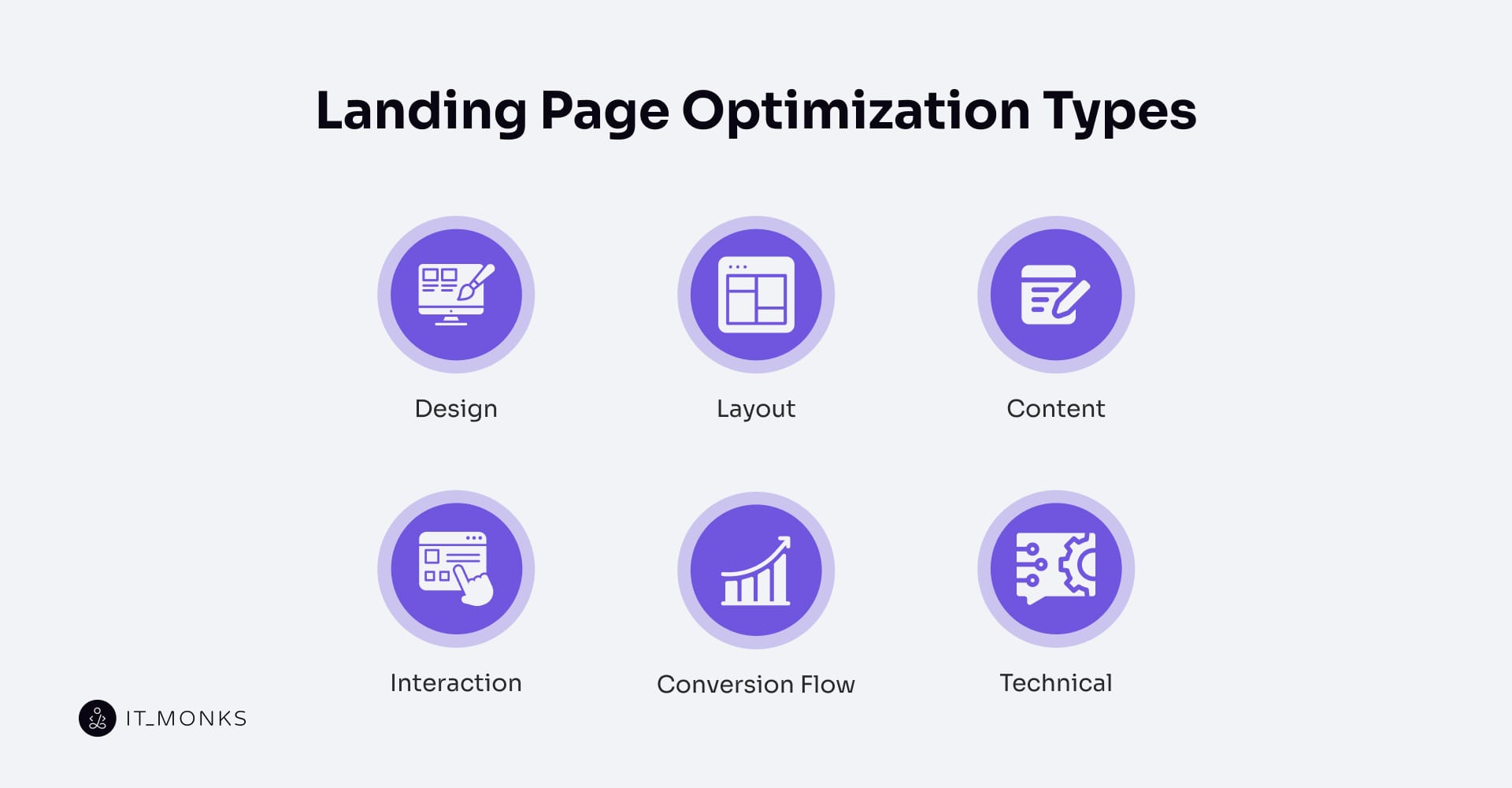
- Design establishes visual hierarchy and clarity, helping users identify priorities and recognize the primary action without cognitive overload.
- Layout structures content order and fold hierarchy, directing attention through the page in a sequence that supports decision-making.
- Content communicates intent-relevant value and context, enabling users to quickly understand the offer and its relevance to their intent.
- Interaction patterns define how users engage with elements such as forms, buttons, and navigation, reducing uncertainty and supporting predictable action paths.
- Conversion flow organizes steps and calls to action into a coherent progression, minimizing drop-off between intent and completion.
- Technical performance ensures that speed and responsiveness do not interrupt attention or delay interaction at critical decision points.
Analytics measure how well the page components drive the intended action. Performance metrics show which page components help or hinder user conversion.
Within this evaluation process, heatmaps reveal how users allocate attention and interact with components, exposing friction points such as low CTA interaction, stalled scroll behavior, or hesitation to interact.
A/B or multivariate testing is then used to validate specific optimization hypotheses by comparing controlled variations and confirming which changes reliably improve measured outcomes.
Why Landing Page Optimization Matters
Landing page optimization matters because it directly ensures that visitor actions align with business objectives. Its role is to improve how effectively web visitors complete defined actions once they arrive on the page.
By influencing conversion rate as the primary performance metric for landing pages, LPO affects both macro outcomes (such as qualified lead generation, revenue contribution, and cost-per-acquisition efficiency) and micro-conversions (such as form submissions, button clicks, and scroll completion). Together, these metrics indicate how effectively a page performs its intended role.
Landing page optimization also impacts revenue efficiency by improving acquisition performance and lead quality. Higher conversion rates and lower form abandonment reduce cost per acquisition, while clearer conversion paths produce more qualified, action-ready leads, increasing return on investment.
Optimization is necessary because traffic sources generate different intent signals and behavioral patterns. Visitors from paid campaigns, organic search, or referral links come with distinct expectations, and a static page cannot accommodate this variation. Optimization adjusts content emphasis, interaction sequencing, and conversion clarity to these contextual differences, preventing performance loss caused by uniform presentation.
Landing page optimization reduces friction that disrupts decision-making. Unclear messaging, dense layouts, and inefficient interaction paths increase hesitation, suppress scrolling, and distort click behavior. By removing these sources of resistance, optimization preserves behavioral flow and prevents measurable declines in engagement and conversion efficiency.
Types of Landing Page Optimization
Design Optimization
Design optimization is the process of refining the visual elements of a landing page (such as headlines, copy, visuals, forms, and calls to action) to create a more persuasive user experience that drives conversions.
Design optimization increases CTA visibility and visual clarity by refining color contrast, improving font readability and size, and strengthening visual hierarchy so attention focuses on conversion-critical elements rather than dispersing across competing blocks. It also recalibrates whitespace distribution to reduce cognitive load, improves button prominence to increase click confidence, and maintains brand consistency to reduce hesitation that appears when visual cues feel inconsistent with expectations.
Design optimization is triggered by behavior patterns that reveal visual friction.
- Heatmap data and eye-tracking reveal where user attention focuses or misses key elements.
- Time to first click indicates how quickly users find the action point.
- Scroll hesitation near critical sections signals confusion or weak hierarchy.
- Mouse movement density over visual blocks indicates uncertainty without commitment.
These signals justify changes to contrast, readability, hierarchy, spacing, and button visibility because they directly affect measurable engagement with conversion-oriented elements.
Layout Optimization
Layout optimization is the process of restructuring page flow and element positioning to improve navigation clarity and accelerate progression toward the conversion. It refines content block order, above-the-fold positioning, and section hierarchy so users encounter essential information in the sequence they naturally scan. Layout optimization also adjusts spacing between sections to support visual grouping and scan rhythm, recalibrates CTA placement to match decision points, and refines column/grid structure or fixed vs. dynamic element positioning to prevent missed content and reduce friction during vertical flow.
Layout optimization relies on behavioral evidence that shows how users move through the page.
- Scroll maps and viewport analytics reveal whether fold visibility and sequencing support scroll engagement.
- Click maps show whether CTA placement matches attention focus.
- Session recordings surface delays that increase time to CTA interaction.
When these signals align with reduced bounce rates, especially on mobile, layout optimization confirms that structure and positioning guide action rather than forcing users to search for it.
Content Optimization
Content optimization is the process of refining the page’s verbal and informational structure so message clarity and semantic alignment support intent-driven action. Content optimization adjusts headline clarity, improves subheading structure, and manages paragraph length so users can interpret the offer quickly without reading fatigue. Content optimization also aligns keywords with user intent, calibrates messaging to traffic source, and clarifies the value proposition, ensuring the CTA context remains logical when users decide whether to proceed.
Content optimization is triggered by measurable reading behavior and conversion context signals.
- Time on page, bounce rate, and scroll depth indicate whether users are engaging with the message or disengaging early.
- Scroll tracking reveals where attention drops.
- Heatmaps over text sections expose engagement hotspots and skipped blocks.
- Session recordings reveal scanning patterns that signal message friction.
When scroll drop-off occurs before the CTA or form start, or when the form start rate declines after value proposition exposure, content optimization targets the specific content attributes that are failing to translate intent into action.
Interaction Optimization
Interaction optimization is the process of adjusting interactive elements so that user actions occur with less hesitation and greater precision along the conversion path. Interaction optimization refines CTA behavior to reduce interaction delay, adjusts hover actions so trigger zones communicate intent clearly, and corrects clickable areas to prevent misclicks or search friction. Interaction optimization also streamlines form input flow to reduce form abandonment, strengthens in-page navigation anchors to support controlled continuation, and calibrates micro-interactions.
Interaction optimization is driven by behavioral signals that reveal where intent fails to translate into action.
- Click-through rate and action timing reveal whether interactive prompts function as decision endpoints.
- Hover dwell time indicates discoverability gaps.
- Form interaction drop-off identifies friction in completion behavior.
When a click-and-scroll heat map shows interaction density clustering away from the primary CTA or dispersing across non-action elements, the interaction optimization targets the specific receivers causing hesitation.
Conversion Flow Optimization
Conversion flow optimization is the process of restructuring the step sequence and decision chain that moves a user from entry to taking the intended action on the landing page. Conversion flow optimization adjusts CTA ordering and placement along the journey, refines form appearance timing and trigger logic, and manages modal or pop-up entry points so they support progression rather than interrupt it. It also strengthens progress indicators and visual step guides to reduce cognitive load between steps, and reduces exit-point exposure within the flow to prevent mid-journey abandonment.
Conversion flow optimization responds to measurable interruption patterns across the funnel.
- Step-level funnel analytics reveal where funnel drop-off increases.
- Path analysis maps CTA interaction sequences that fail to progress.
- User session recordings show where users abandon the decision chain.
- Time delay between flow events highlights pacing problems that slow completion.
When these signals indicate that the step sequence or CTA sequencing is misaligned with real behavior, flow optimization reorders progression logic to increase completion rate and reduce abandonment.
For deeper context on how progression logic ties to measurable outcomes, our practical conversion rate optimization guide helps frame flow decisions around conversion pacing and drop-off control rather than fixed templates.
Technical Optimization
Technical optimization is the process of improving the execution performance so that load, rendering, and interaction readiness do not block conversion-critical behavior. Technical optimization targets page load speed, rendering time across devices, script and resource management, image compression and lazy loading, caching behavior, browser compatibility, and mobile responsiveness as technical attributes that determine how reliably the page becomes usable. These attributes directly influence time to interaction (TTI), first input delay (FID), and cumulative layout shift (CLS), which affect whether users can scroll, click, and submit without delay-driven abandonment.
Technical optimization is triggered by underperformance detected through behavior and performance evidence.
- Performance reports and user device logs expose device-specific loading patterns.
- Interaction latency indicates delayed clicks or scroll interruptions.
- Session interruption patterns reveal exits during loading or after unstable rendering.
When bounce on slow load increases, especially on mobile, technical optimization stabilizes delivery and interaction timing so the previously optimized design, layout, content, interaction, and flow can function without execution blocking or responsiveness failures.
Best Practices of Landing Page Optimization
Show the Value Proposition Immediately
The value proposition is the benefit-focused message that explains what the page offers and why it matters to the visitor. Top-of-page positioning with above-the-fold visibility reduces bounce rate triggers caused by informational delay and increases the likelihood that users begin the conversion path with clear benefit comprehension.
Early visibility ensures that benefit clarity, relevance, and message-to-intent alignment are processed before the first scroll. Weak attention concentration in the opening viewport, mouse hesitation near the top section, or a long time to first scroll, combined with low CTA visibility, signals that users lack a reason to continue. In these cases, repositioning or clarifying the value proposition reduces bounce rate and increases progression into the conversion flow.
Align the Page With User Intent
User intent alignment is the process of matching inbound signals to the page’s entry content and action path so visitors recognize relevance quickly and proceed with less friction. This alignment optimizes headline phrasing, page entry content priority, CTA relevance to query, value proposition specificity, and message framing tied to acquisition source based on search query terms, ad copy or campaign parameters, referral source context, and user journey stage.
The impact of intent alignment is measured through expectation matching at entry. High bounce rates from specific campaigns, short session duration on query-driven landings, or missing CTA interaction despite clear intent signals indicate a semantic mismatch. Scroll hesitation or rapid backtracking after the first content block further confirms misalignment. In these cases, refining entry messaging and CTA targeting reduces friction and improves time-to-interaction.
A structured user behaviour analysis layer enables this process by linking traffic context and session behavior directly to the page components that require adjustment to satisfy user intent.
Highlight One Clear Primary CTA
A primary CTA is the single most important action prompt on the page, and emphasizing it is the practice of establishing action hierarchy to reduce decision friction. Primary CTA prioritization assigns visibility and positioning priorities to the intended action, limits competing links or buttons that create CTA confusion, and maintains message-action alignment so the page communicates a single dominant decision path.
The primary CTA emphasis is justified by interaction signals that reveal ambiguity. Click-through rate relative to impression rate indicates whether the CTA is recognized as the decision endpoint; hover dwell time across multiple action points signals uncertainty; and click distribution heatmaps reveal whether engagement disperses across secondary elements rather than concentrating on the primary action. When users scroll past the CTA without interacting or repeatedly engage with less relevant buttons, the engagement gap indicates that action clarity is not established at the right point in the page flow.
Validation commonly relies on controlled comparisons, such as A/B testing, to confirm that removing competing actions and strengthening the primary CTA’s structural priority increases intended interaction frequency and reduces misdirected engagement.
Ensure Fast, Responsive Page Performance
Fast, responsive performance minimizes the delay between page load and usable interaction, and between user input and visible response. Performance optimization targets load speed, time to interactive, input latency, mobile rendering, and layout stability because latency directly delays conversion initiation.
Performance issues surface as exits before interaction, abandonment during loading, delayed scrolling, or misclicks caused by a layout shift. Rising time to interactive stretches decision timing, while unstable layouts increase hesitation at the first click. Improving speed and stability reduces friction to first action, increases engagement on mobile entry, and raises conversion probability through interaction readiness rather than visual changes.
Eliminate Distractions From the Main Action
Distraction elimination removes non-essential elements that compete with the primary CTA and disrupt the flow of attention. These include multiple equal-weight CTAs, early external links, auto-play media, unrelated popups, excessive form fields, and visually dominant secondary content.
Attention leakage appears as click dispersion, scroll regression, or exits following non-primary interactions. Session recordings often reveal hesitation at decision points due to competing elements. Removing off-path components focuses attention on the main action, reduces misclicks, and improves the speed of progression through the conversion sequence.
Reduce Form Friction to the Minimum
Form friction is the measurable resistance users encounter during form interactions, as evidenced by hesitation, errors, and abandonment. Form optimization reduces friction by limiting field count, clarifying input requirements, improving validation behavior, and adapting usability for mobile input.
High drop-off rates, incomplete submissions, long dwell time on specific fields, or scroll-away behavior indicate where friction occurs. Field overload increases perceived effort, unclear labels create validation loops, and mobile typing difficulty amplifies abandonment. Reducing these barriers shortens completion time, increases submission rate, and lifts final conversion performance on form-driven pages.
Use Trustworthy, Specific Social Proof
Social proof reduces conversion hesitation by providing third-party validation that supports decision confidence. Optimization focuses on the specificity of testimonials, source credibility, contextual relevance, and placement within the decision path.
Hesitation before CTA interaction, pauses over proof sections, or clicks on review and case study links signal risk evaluation. When introducing verifiable, relevant proof lowers bounce rate, increases form completion, or improves CTA engagement in controlled tests, social proof functions as a performance driver. Generic or unverifiable proof fails to resolve risk, while specific, recognizable validation shortens decision time and supports confident action.
Landing Page Optimization on WordPress Websites
Landing page optimization in WordPress applies the same conversion-focused principles discussed throughout this guide, but executes them within the structural and operational constraints of a WordPress environment. The optimization agent remains the landing page optimization itself; WordPress serves as the delivery layer that shapes how design, layout, content, interaction, flow, and technical adjustments are implemented and how reliably they perform.
Within WordPress, template structure and theme logic directly influence layout optimization by defining content order, fold behavior, and section hierarchy at a block level. Block-based layout rules determine how elements stack, persist, or shift during scroll, which affects attention flow and CTA visibility. Theme responsiveness further constrains or enables layout sequencing by controlling how those blocks adapt across viewports, shaping mobile render consistency and scroll engagement.
Editor constraints and block mechanics affect design and content optimization by setting boundaries on visual hierarchy, spacing control, and content modularity. Reusable templates and block-level styling govern how consistently value propositions, headings, and CTAs are surfaced across landing pages, influencing clarity and alignment of intent without changing the underlying optimization logic.
Plugin-driven interaction handling introduces an additional dependency layer for interaction and technical optimization. Interaction behavior (such as button response timing, form submission handling, and in-page navigation) depends on how plugins execute scripts and manage events. These mechanics can either support predictable interaction paths or introduce latency and friction that must be corrected through optimization.
Form builders, CTA blocks, and conversion-focused components shape conversion flow by defining step sequencing, trigger timing, and submission logic under CMS rules. Their configuration affects form friction, mid-flow abandonment, and progression stability, making them receivers of optimization actions when behavioral data reveals drop-off or hesitation.
Performance metrics in WordPress environments reflect CMS-specific execution factors, such as render-blocking scripts, caching behavior, and mobile rendering, which are governed by theme responsiveness. These attributes influence load speed, interaction readiness, and layout stability, which in turn affect bounce behavior and action timing. Landing page optimization addresses these constraints by adapting how components are structured and delivered to improve conversion behavior within WordPress-specific latency and rendering conditions.

Contact
Don't like forms?
Shoot us an email at [email protected]