- Expertise
Expertise That Drives Results
Explore our specialized services, tailored solutions, and industry expertise to elevate your digital presence. From custom WordPress development to seamless integrations, we build high-performing websites that deliver impact.
Solutions- Booking System Integrations
- Headless & REST API WordPress
- Hubspot Integration
- Enterprise WordPress
- Website Migration
- Internal Collaboration Platforms
- External Communications Hubs
- Work
- About
- Proof
- Contact
Learn more


AI Search Visibility and the New Rules of SEO

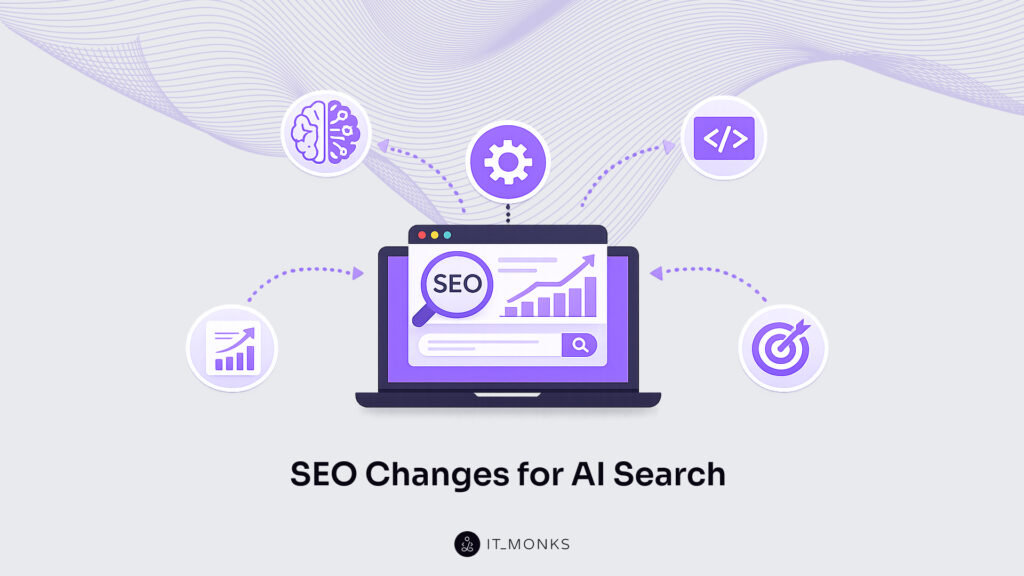
Buyers now research through four different front doors before your website ever comes up: TikTok, a ChatGPT or Claude conversation, a Reddit thread, or Google’s own AI Overview. Google used to be the only door. Not anymore, and that shift is exactly what generative engine optimization (GEO) exists to address.
64% of Gen Z already use TikTok as a search engine, according to Adobe’s research. OpenAI says ChatGPT alone handles 2.5 billion prompts a day. A significant amount of those prompts are questions your website used to answer first, and now never gets asked at all.
Getting found by a human and getting understood by a machine are two different problems now. Most SEO strategies are still only built to solve one of them, which is the whole gap AI search visibility work is meant to close.
AI Search Optimization vs Traditional SEO
Rankings, traffic, and clicks still matter. Keep the dashboard you’ve been running for ten years. What’s missing is the second half: how often your brand gets cited inside AI answers.
Ranking on Google means less if an AI system can’t read your site well enough to cite it. You could hold position one for a keyword and still be invisible in the Google AI Overview sitting directly above your listing, or in the ChatGPT answer someone got instead of ever opening a search engine.
That’s the practical difference between AI search optimization and traditional SEO: one measures clicks, the other measures whether you got mentioned at all.
| Traditional SEO | AI Search Optimization | |
|---|---|---|
| Core question | Did we rank on page one? | Did an AI system cite us at all? |
| Primary metric | Rankings and organic traffic | Citation frequency in AI answers |
| Success signal | A click to the website | A mention, with or without a click |
| Main audience | Human readers scanning results | AI crawlers and LLMs parsing content |
| Content unit that wins | A page that ranks for a keyword | A passage an AI model can lift and cite |
| Where visibility shows up | Search engine results page | AI Overviews, ChatGPT, Claude, Perplexity, TikTok Search |
| What gets measured | Position, impressions, CTR | Share of voice inside AI answers, presence in AI Overviews |
| Tooling maturity | Established, decades of tooling | Early, most teams have no dashboard for it yet |
New numbers need to sit next to the old ones: citation frequency in AI answers, share of voice inside AI Overviews for your category’s core queries, whether your pages even surface as a source worth pulling from.
Google AI Overview SEO is really just this: treating the Overview box as its own ranking surface, with its own visibility metric, instead of an afterthought bolted onto classic search tracking. Most marketing teams aren’t tracking any of this yet.
Technical SEO for AI Crawlers
Three things decide whether an AI crawler finds your best content or gives up halfway through your site. We check all three on every client site now, and together they’re most of what it actually takes to optimize a website for AI search engines, before a single word of new content gets written.
- Does the crawl path dead-end anywhere? A 404, a broken redirect chain, an orphaned page nobody links to anymore, all of them block an AI crawler the exact same way it’s always blocked Googlebot. Nothing new here technically. What’s new is the stakes.
- Is internal linking strong enough to actually surface your best pages? A lot of sites have one genuinely excellent, citable piece of content buried three tiers deep in a blog archive nobody links to. If your own site doesn’t treat that page as important, why would a crawler.
- Is anything buried more than three clicks deep? Old rule of thumb, still true, maybe truer now. An AI crawler has no patience and no incentive to dig the way a stubborn human sometimes will.
Why 2020-Era Content Doesn’t Rank in 2026
Content that ranked in 2020 is often invisible in 2026, even with the same effort and the same polish put into it. That’s not you doing something wrong. It’s the ground shifting under a strategy that used to work fine.
For years, SEO was mostly a volume game: write more, hit the keywords, build the links, ship the pages. It worked, because Google’s ranking systems mostly rewarded output and competent execution. You could produce your way to the top.
Google now decides what ranks using E-E-A-T: Experience, Expertise, Authoritativeness, Trust. Trust sits at the center, and the extra E, Experience, got added in 2022 for a specific reason: Google wants proof that a real person with real, first-hand knowledge stands behind a page. Not another competent article assembled from the same five sources everyone else used.
What Trust as Architecture Looks Like
Four things separate a site that reads as trustworthy to a machine from one that only reads that way to a human.
- Structured author and entity data. Schema markup connecting an author to verifiable credentials, sameAs links pointing to real profiles, Organization and Person entities actually defined in a way machines can parse. A name in italics under a headline proves nothing to a crawler.
- Proof living as real, crawlable text, not a PDF or an image. Case studies, data, actual specifics about what the person or company has done. If your best proof of expertise is a downloadable whitepaper behind a form, it’s invisible to the systems deciding whether to trust you, the same way it would be if a marketer couldn’t even select that text with their cursor.
- Fast, secure pages. Core Web Vitals, HTTPS, the unglamorous basics that have quietly functioned as trust signals for years and haven’t stopped mattering just because everyone’s talking about AI now.
- Consistency across the whole site. Matching business information, aligned author bios that don’t contradict themselves page to page, entity signals that hold together instead of fragmenting depending on where you look.
You can publish the most credible content in your entire industry. If the site can’t express that credibility structurally, none of it counts toward how you’re evaluated. Content team does everything right, technical foundation quietly undermines all of it.
Bringing Both Halves Together
Content strategy and technical SEO can’t be separate workstreams anymore. Content proves expertise. Architecture proves that expertise is real and machine-readable. You need both running at the same time, on the same page.
Audit crawl paths and internal linking at the same time you audit structured author and entity data. Treat it as one project, because it functionally is one now, not two backlog items different people get to separately.
If you’ve already looked at how schema markup supports AI visibility, this is the same logic one layer up, applied to the whole site’s architecture instead of individual pages.
What Wins Next Isn’t Who Publishes the Most
The brands that win search next year won’t be the ones producing the most content. They’ll be the ones whose websites are engineered to be believed, by people scanning a page and by machines deciding whether to cite it.
Your website stops being a brochure somewhere in this shift. It becomes the source machines pull answers from.
Run the opening-line test and the cursor test on your top five pages this week. Most sites lose AI search visibility long before anyone writes a single new article, and no amount of generative engine optimization theory fixes a page a crawler never actually reached.
When did you last read your own site the way a machine does?
More Articles by Topic
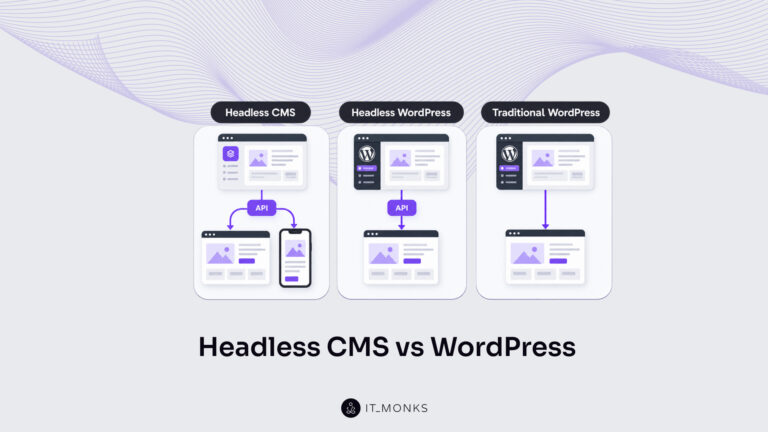
Headless CMS vs WordPress is a comparison of two choices made at once: an architecture choice between a coupled site…
Learn more 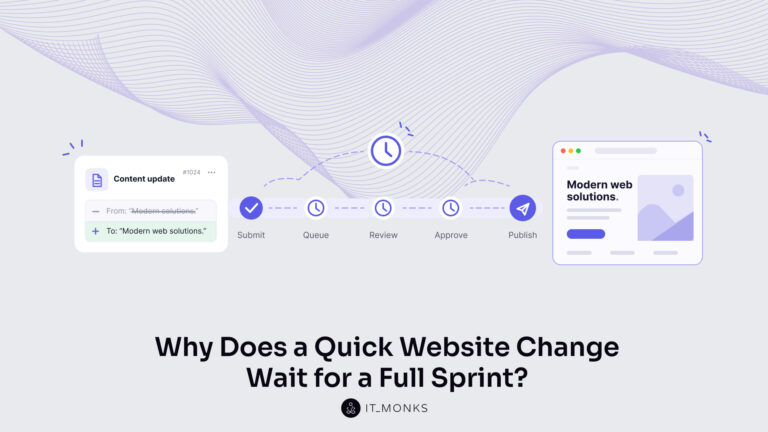
The new campaign copy is approved. The ads go live on Monday, and the landing page they point to still…
Learn more 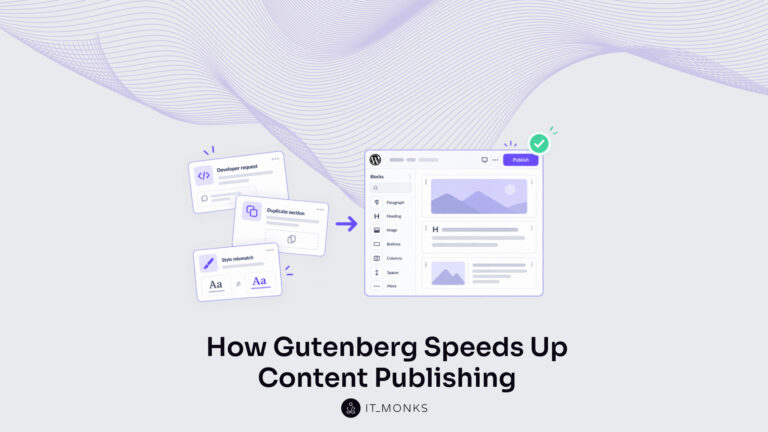
Imagine a marketing team two days before a campaign launch. The copy is approved, the images are ready, and the…
Learn more Contact
Feel free to reach out! We are excited to begin our collaboration!
Don't like forms?
Shoot us an email at info@itmonks.com
Don't like forms?
Shoot us an email at info@itmonks.com

CEO, Strategic Advisor
Reviewed on Clutch
 ChatGPT
  Claude
  Grok
Grok  Gemini
 Send a Project Brief
Fill out and send a form. Our Advisor Team will contact you promptly!