Explore our specialized services, tailored solutions, and industry expertise to elevate your digital presence. From custom WordPress development to seamless integrations, we build high-performing websites that deliver impact.
Ten manufacturer websites clear a bar that most of their field never reaches. This ranking of the best manufacturing websites puts those ten in order, not by how they photograph in a portfolio, but by how they perform for the people who actually work with them: the technical buyer weighing two parts, the procurement team assembling a shortlist, the engineer hunting a datasheet an hour before a supplier call.
Every site here earns its place on real website performance, measured against the same five things. How fast the page loads under Core Web Vitals. How much genuine product specification it puts on the page. Whether a quote request begins at the product itself or drops the buyer into a catch-all form. Which certifications sit in public view. And how cleanly the site works for a visitor using assistive technology. Those five criteria set the order, and the best industrial websites tend to satisfy all five at once.
What separates this ranking from the usual best manufacturing website design roundup is its footing. The order comes from our own research across 79 US manufacturer websites, each graded against the same yardstick, so the ranking rests on data rather than an editor’s eye for a handsome layout. Every entry belongs to a US company that manufactures in house, and the ten run one through ten, strongest first.
What actually separates a best-in-class manufacturer website from an ordinary one is a specific, testable standard, and it starts with what a technical buyer can do on the page.
What Is a Best-in-Class Manufacturer Website?
A best-in-class manufacturer website, in web design and development terms, is one built to the conventions the wider profession already treats as good practice, the shared UI/UX and development standards that experienced buyers, designers, and engineers recognize on sight. Best-in-class is not a private definition. It is the industry-standard consensus about what a competent manufacturing website design delivers.
That consensus resolves into five concrete behaviors.
A best-in-class manufacturer website loads fast, holding its Largest Contentful Paint inside the range Core Web Vitals treats as good.
It exposes real product specifications (dimensions, materials, ratings, tolerances) instead of marketing copy, and backs them with downloadable datasheets.
It provides a quote or request-for-quote path that opens from the exact product a buyer is looking at, not a generic contact form.
It shows its certifications publicly, so a compliance-driven procurement team can confirm ISO 9001 or AS9100 before it ever makes contact.
And it meets accessibility standards, working cleanly with the assistive technology a real visitor may depend on. Miss several of these and a site falls out of contention, however polished its visuals.
Those same five criteria anchor a study we ran across 79 US manufacturer websites, each site measured against every criterion on one common scale, which is where this ranking comes from. The full method, the per-criterion detail, and every site’s result are documented in our US Manufacturer websites performance research.
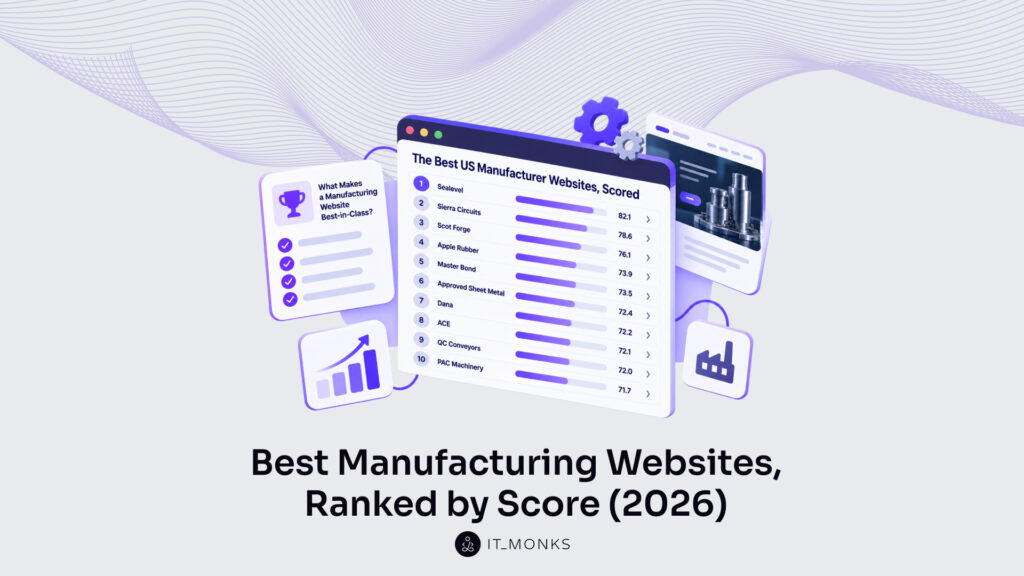
The ten sites rank strongest first, each defined by a single lead trait and the tradeoff that comes with it.
Rank
Site
Domain
Score (0–100)
Verdict
1
Sealevel
sealevel.com
82.1
Deep product specifications on a fast page; a slimmer accessibility margin than the cleanest of the field.
2
Sierra Circuits
protoexpress.com
78.6
The deepest specifications and fullest certifications of the set, held back by the slowest load.
3
Scot Forge
scotforge.com
76.1
One of the fastest loads with near-perfect accessibility; the product quote drops to a generic form.
4
Apple Rubber
applerubber.com
73.9
Fast pages carrying deep O-ring specifications; a generic 134-field quote form at peak intent.
5
Master Bond
masterbond.com
73.5
Very deep adhesive properties with a real product quote path; thin public certifications.
6
Approved Sheet Metal
approvedsheetmetal.com
73.4
The fastest-tier load with strong accessibility; product pages that omit part dimensions.
7
Dana
dana.com
72.2
Flawless accessibility and real e-axle specifications; average load speed and a generic contact form.
8
ACE (American Control Electronics)
americancontrolelectronics.com
72.1
Real drive spec tables and a one-field product quote; average load speed and a critical accessibility fault.
9
QC Conveyors
qcconveyors.com
72.0
The strongest per-model specification depth; a quote path that dead-ends at a bare configurator.
10
PAC Machinery
pacmachinery.com
71.7
Deep bagger spec tables and public ISO 9001; the softest performance of the set and a generic quote form.
Sealevel takes the top position, and its pairing of deep product specifications with a fast page is where the ranking begins.
1. Sealevel
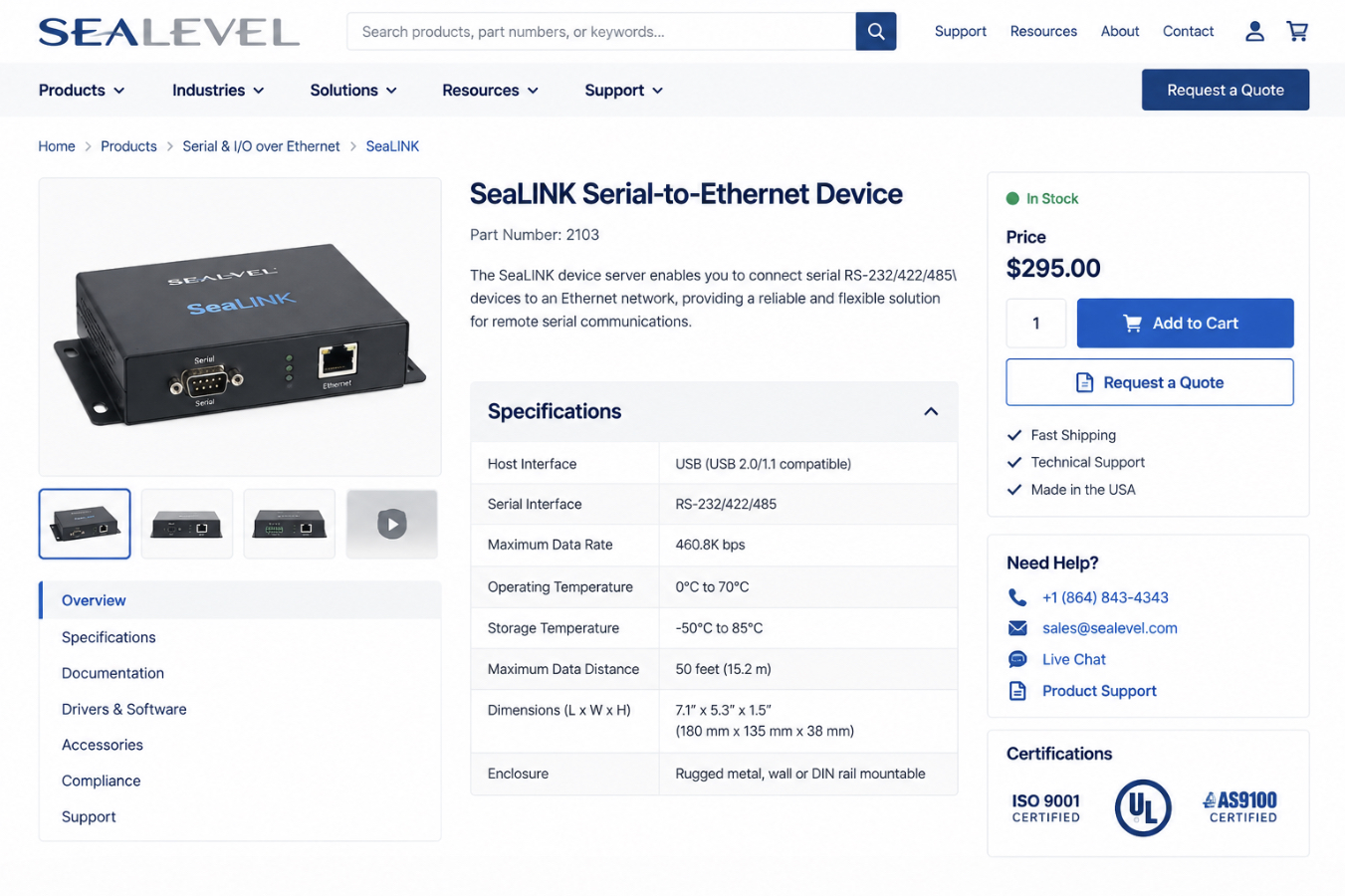
Sealevel takes the top position because its website gets two fundamentals right at the same time: technical product pages are detailed enough for an engineer to evaluate a product, and they remain fast enough that accessing that information does not become a barrier.
That balance matters on manufacturing websites. Product pages often become either too thin to support a purchasing decision or overloaded enough to hurt usability and performance. Sealevel avoids both problems.
Performance
Performance is the primary criterion. A Sealevel product page returns its largest content in a Core Web Vitals Largest Contentful Paint of 2,226 milliseconds at the 75th percentile, 2.2 seconds, a FAST result under Core Web Vitals thresholds, corroborated by a lab performance score of 62.
That means a technical buyer can reach the information they need without waiting through a slow product experience.
Product specifications
The product pages also provide the level of detail expected from a strong manufacturing website. Specifications are presented as structured technical information rather than buried inside marketing copy.
A buyer can find the elements needed to evaluate product fit, including:
interface and compatibility information
operating and performance limits
environmental specifications
dimensions and physical characteristics
technical measurements and ratings
supporting product documentation
This allows engineers and procurement teams to qualify a product before contacting sales, which is one of the clearest signs of a useful manufacturer product page.
Quote path and trust signals
From that same product context, the quote path stays product-aware. An Add to Cart / request-for-quote control lives on the product page and opens a 14-field form, so the buyer moves from reviewing a product to requesting a price without losing the product context.
Sealevel also makes its trust and compliance signals easy to verify. The site publicly presents ISO 9001, UL certification, and AS9100, along with the assembly standards it follows, including IPC-A-610, J-STD-001 and RoHS.
Accessibility
The site’s weakest point is accessibility. An automated axe scan returns zero critical rules and a single serious rule, link-name. That is still a relatively clean result, but it leaves a slightly smaller accessibility margin than some other sites in the ranking, particularly where ambiguous link text may affect screen-reader users.
Final score
In our 79-site research, Sealevel earns 82.1 out of 100, first of the seventy-nine.
Its strongest advantage is not one individual product page feature, but how the pieces work together: fast loading, structured specifications, visible compliance information, and a quote path that remains connected to the product being evaluated. Sierra Circuits, ranked next, goes even further on specification depth, but gives up some performance to do it.
2. Sierra Circuits
Sierra Circuits, which trades as Protoexpress, ranks second because its website provides some of the most detailed technical product information in the group. Engineers can evaluate manufacturing capabilities in depth before contacting sales, but that advantage is weakened by the slowest real-world page load among the ten sites.
The result is a site with exceptionally strong product information, but a clear usability tradeoff: the content is valuable only if buyers can reach it quickly enough.
Product specifications
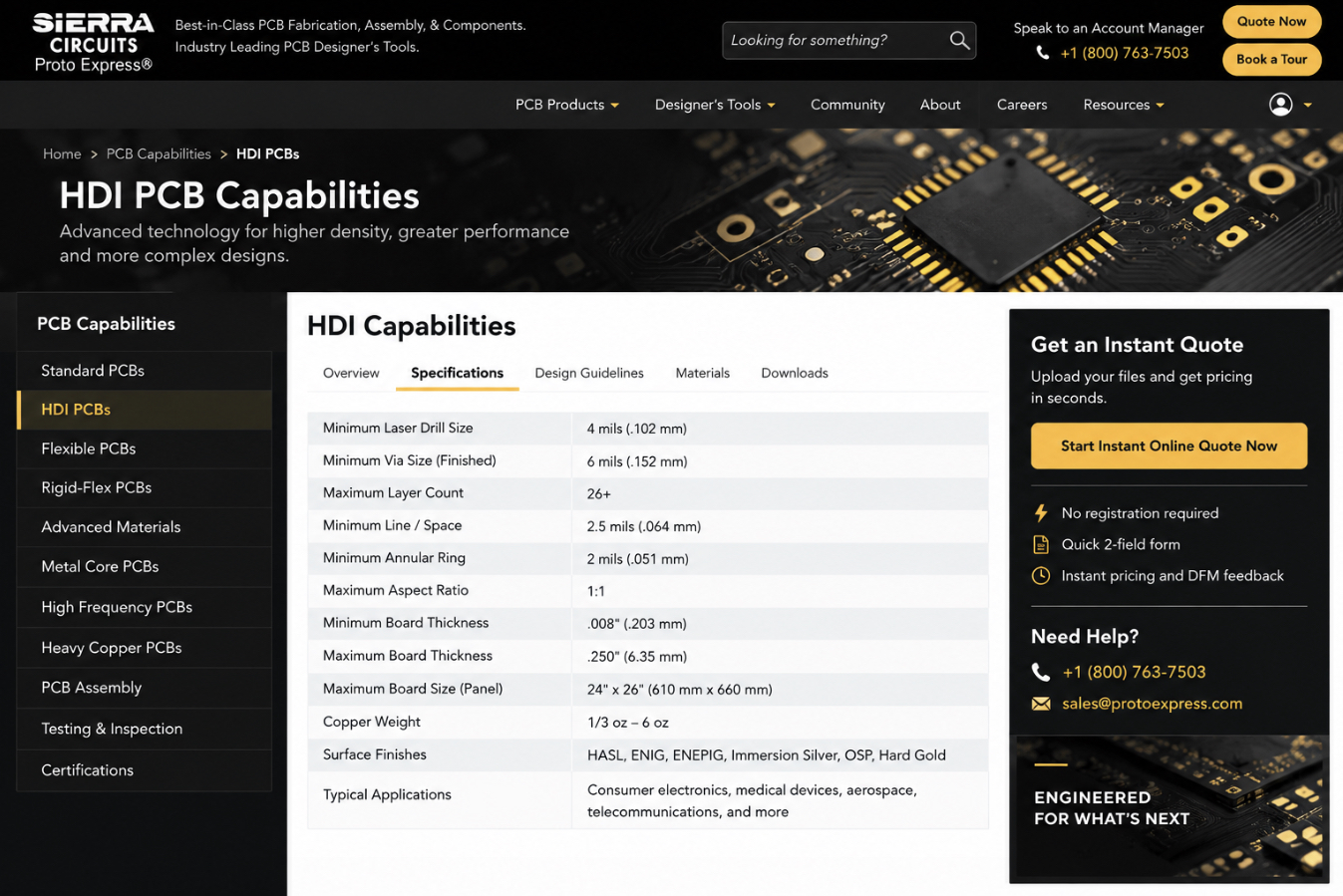
The product pages set a high standard for technical depth. Instead of relying on broad marketing claims, Sierra Circuits organizes manufacturing capabilities into structured engineering tables.
Across its capability pages, buyers can find the types of information that matter when qualifying a supplier, including:
manufacturing limits and tolerances
supported materials and construction options
size and dimensional ranges
layer and thickness capabilities
process-specific technical requirements
detailed capability tables for different product types
This level of specification helps engineers determine whether a manufacturer can meet project requirements without first submitting a general inquiry.
Quote path and certifications
The quote path supports that research process well. A “Start Instant Online Quote” control appears directly within the product context and opens a lean 2-field form, one of the shortest routes to a quote in the group.
The site also makes a broad set of certifications visible:
ISO 9001
UL
ISO 13485
AS9100
ITAR
Together, these signals give procurement teams an immediate way to verify whether the manufacturer is suitable for regulated industries such as medical, aerospace, and defense.
Performance
Performance is where the experience falls behind.
The site’s Core Web Vitals Largest Contentful Paint reaches 5,153 milliseconds at the 75th percentile, 5.2 seconds, the slowest result among the ten and well inside the SLOW band under Core Web Vitals, even though a synthetic lab run reaches 96.
That gap matters because product depth only helps when buyers can access it without friction. A slow first render delays the specification tables and capability information that are the site’s strongest feature.
Accessibility
Accessibility creates another barrier. The site returns four critical axe rules:
aria-required-children
image-alt
input-button-name
meta-refresh
It also returns four serious issues, including color-contrast.
These problems can make important technical content harder to use with assistive technology, reducing access to the same product information that otherwise makes the site strong.
Final score
In our 79-site research, Sierra Circuits earns 78.6 out of 100, second of the seventy-nine.
Its product pages show what strong manufacturing content should provide: structured technical specifications, clear capability limits, visible certifications, and a direct quote path. The main weakness is that performance and accessibility make that information harder to reach than it should be. Scot Forge, ranked third, shows the opposite balance with much faster page performance.
3. Scot Forge
Scot Forge ranks third because its website combines strong page speed with one of the cleanest accessibility results in the group. Technical information is easy to reach and the site performs well, but the experience becomes less effective when a buyer moves from product research to requesting a quote.
Performance
Speed is one of the site’s strongest areas. The site returns its largest content in a Core Web Vitals Largest Contentful Paint of 1,648 milliseconds at the 75th percentile: 1.65 seconds, firmly FAST and among the quickest pages in the group, though Approved Sheet Metal loads faster still at 1,563 milliseconds.
A lab performance score of 93 supports the field result.
Accessibility
Accessibility is another clear strength. An axe scan returns zero critical rules and only two serious ones:
link-name
color-contrast
That makes Scot Forge one of the strongest sites in the group for keeping important product information accessible to visitors using assistive technology.
Product specifications
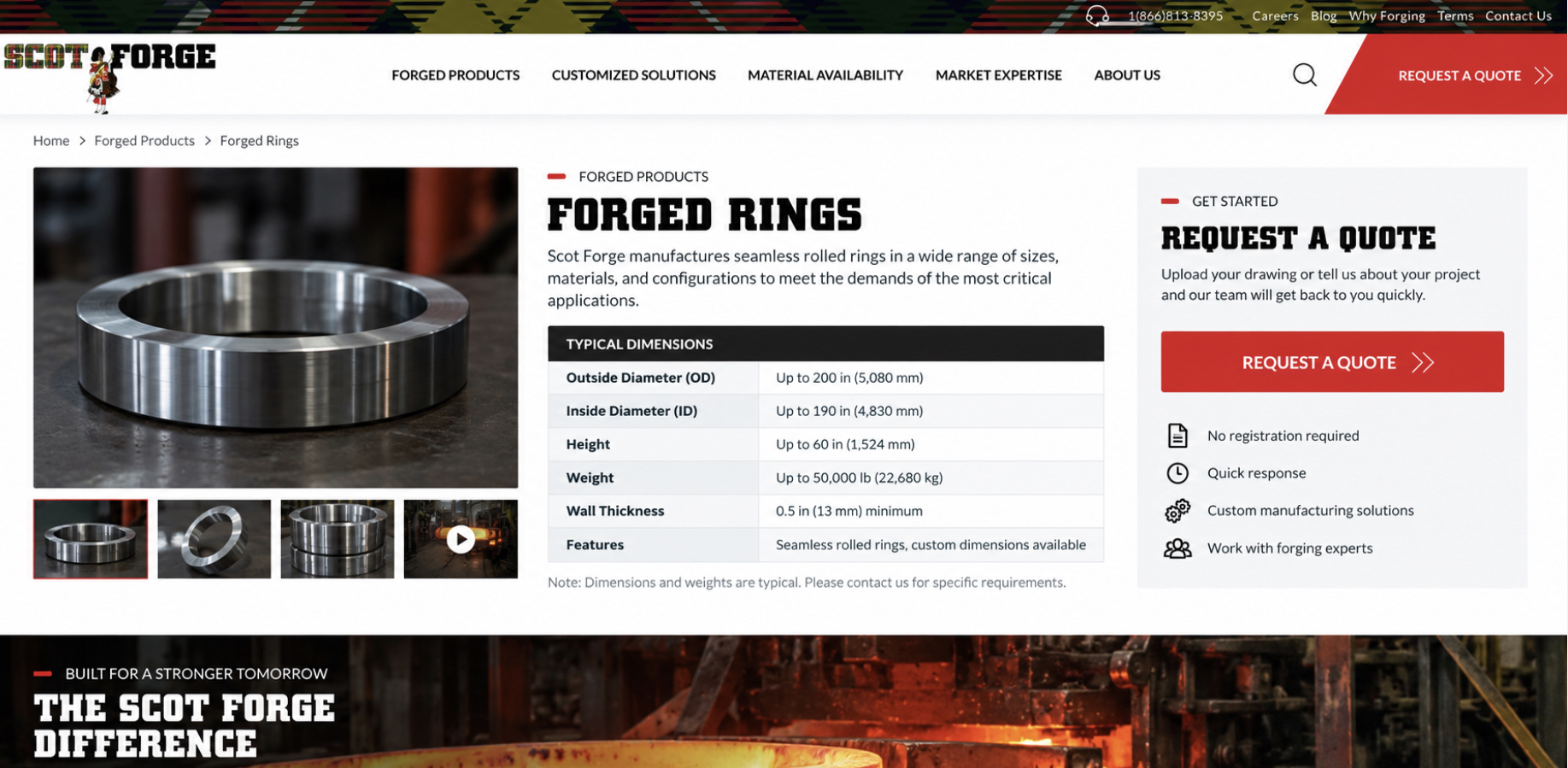
The product pages provide enough technical detail for buyers to understand the manufacturer’s capabilities without relying on broad marketing claims.
The information includes:
supported product dimensions and size ranges
maximum weights and production limits
available material and stock dimensions
manufacturing capacity for different product types
measurable capability ranges that engineers can use for initial supplier qualification
The specification depth is solid rather than exhaustive, but it gives technical buyers enough information to determine whether Scot Forge is relevant to their project before contacting sales.
The site also makes important certifications easy to verify:
ISO 9001
AS9100
Nadcap
ITAR
Quote path
The main weakness appears at the point of highest intent.
On a forged-rolled-rings page, the “REQUEST A QUOTE” button takes the buyer to a generic /contact-us/request-form, a 7-field form that does not preserve the product context.
That breaks the connection between product research and conversion. Instead of carrying the product or capability being viewed into the inquiry, the buyer has to provide that context again manually.
Final score
In our 79-site research, Scot Forge earns 76.1 out of 100, third of the seventy-nine.
Its strongest qualities are speed, accessibility, and clear technical capability information. The main opportunity is the quote experience: a product-aware RFQ path would make the transition from research to inquiry much smoother. Apple Rubber, ranked next, shows a similar pattern, with strong product information leading into a generic quote form.
4. Apple Rubber
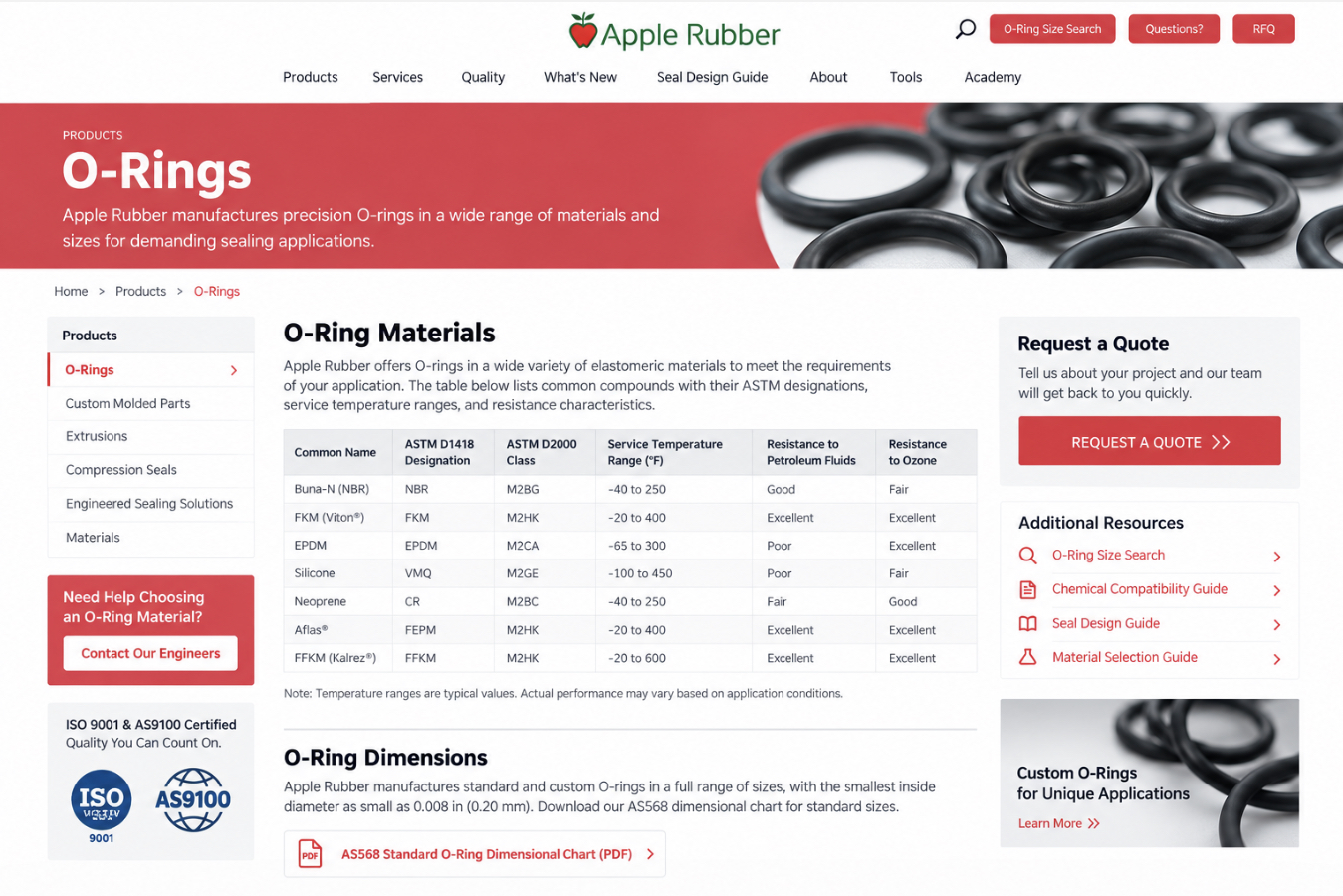
Apple Rubber ranks fourth because its product pages combine fast performance with detailed technical information. Buyers can reach specifications quickly and use the page to evaluate material and fit before contacting sales.
Performance
The O-ring product pages reach their Largest Contentful Paint at 1,917 milliseconds at the 75th percentile in CrUX field data, placing them firmly in the FAST range under Core Web Vitals.
That speed matters because technical product pages often carry large amounts of data. Apple Rubber manages to provide detailed engineering information without making buyers wait for it.
Product specifications
The product pages are structured around the information engineers and procurement teams need to qualify a sealing component.
They include:
standardized material classifications
operating temperature ranges
resistance and performance characteristics
product dimensions and size ranges
industry-standard material references
downloadable dimensional and technical documentation
The site also provides downloadable reference materials such as its AS568 Standard O-Ring Dimensional Chart, allowing buyers to verify dimensions and product fit without leaving the product research process.
Public trust signals reinforce that information. ISO 9001 and AS9100 are both visible on the site, alongside ASTM standards used for material classification.
Quote path
The main weakness appears when a buyer moves from research to requesting a quote.
The product-level RFQ leads to a generic 134-field request-for-quote form that does not carry product context forward. Information the buyer has already identified on the product page, such as the part, material, or size, must be entered again manually.
That makes the quote experience considerably heavier than the product research experience and creates unnecessary friction at the point of highest intent.
Accessibility
The rest of the interface remains relatively clean. An axe scan returns zero critical rules and two serious ones:
color-contrast
link-name
This means the most significant usability issue is concentrated in the quote process rather than across the site as a whole.
Final score
Apple Rubber earns 73.9 out of 100 in our 79-site research.
Its strongest qualities are fast performance and well-structured technical product information. The main limitation is the RFQ experience, which adds friction after the buyer has already done the work of identifying the right product. Master Bond, ranked next, shows the opposite balance: a stronger quote path, but weaker certification visibility.
5. Master Bond
Master Bond ranks fifth because its website performs well across product information, page speed, and the quote journey. Buyers can evaluate products in detail and move directly into a product-specific inquiry. The main weakness is less about usability and more about how clearly the site presents compliance and certification information.
Product specifications
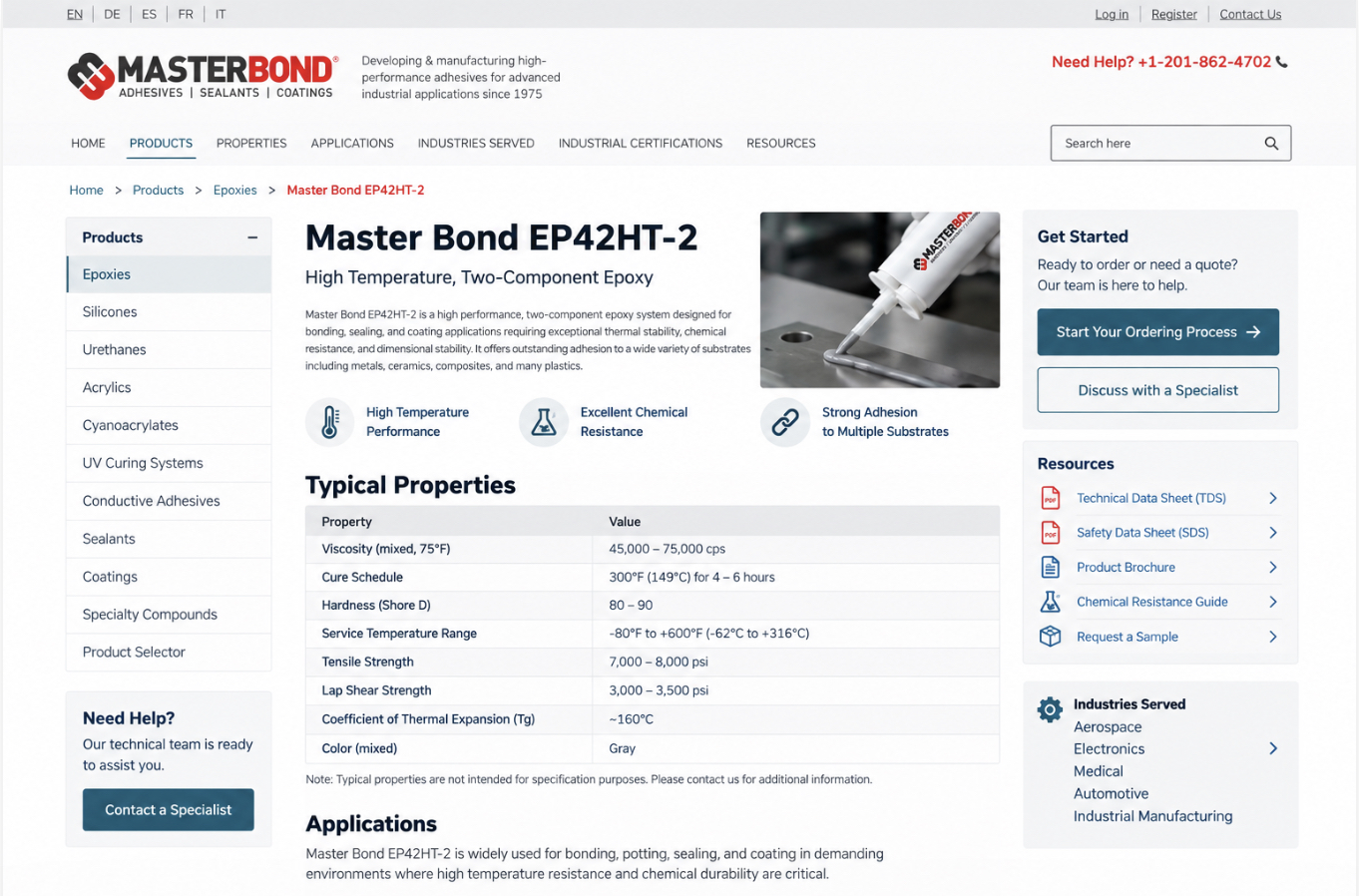
Master Bond’s product pages provide datasheet-level technical information rather than relying mainly on marketing descriptions.
Buyers can find the types of specifications needed to evaluate whether a product is suitable for an application, including:
viscosity and other material properties
curing requirements
hardness and performance characteristics
operating and service temperature ranges
application-specific technical data
supporting product documentation
This level of detail allows engineers to evaluate product suitability before contacting the company and gives procurement teams concrete information to use during supplier qualification.
Performance
The technical depth does not come at the expense of page speed.
Master Bond records a Largest Contentful Paint of 1,975 milliseconds at the 75th percentile in CrUX field data, placing it within the FAST range under Core Web Vitals.
That helps keep dense technical information usable rather than turning detailed product pages into a slow research experience.
Quote path
The quote journey is one of the site’s stronger features.
From the product page, calls to action such as “Start Your Ordering Process” and “Discuss with a Specialist” preserve the product context instead of sending buyers to a generic contact page.
The follow-on form is relatively long at 19 fields, but the buyer does not have to start the conversation from scratch. The product being evaluated remains connected to the inquiry, which creates a more coherent transition from research to sales.
Accessibility
Accessibility is also relatively clean. An axe scan returns zero critical rules and two serious issues related to color contrast.
That means the product information and specialist inquiry path remain broadly usable with assistive technology, with relatively limited accessibility friction compared with many sites in the research.
Certifications and trust signals
The weaker area is certification visibility.
Master Bond presents cGMP/FDA-related information and UL certification, but its public pages do not clearly surface a core ISO 9001 registration.
For procurement teams working in medical, aerospace, or other regulated environments, visible certification information is part of supplier qualification. Strong technical specifications can establish product suitability, but buyers may still need additional verification before moving forward when quality-management credentials are not easy to confirm on the site.
Final score
Master Bond earns 73.5 out of 100 in our 79-site research.
Its strongest qualities are deep technical product information, fast performance, and a quote path that preserves product context. The main limitation is the visibility of certification information. Approved Sheet Metal, ranked next, presents the opposite pattern: speed and trust signals are strong, while the product specifications are less complete.
6. Approved Sheet Metal
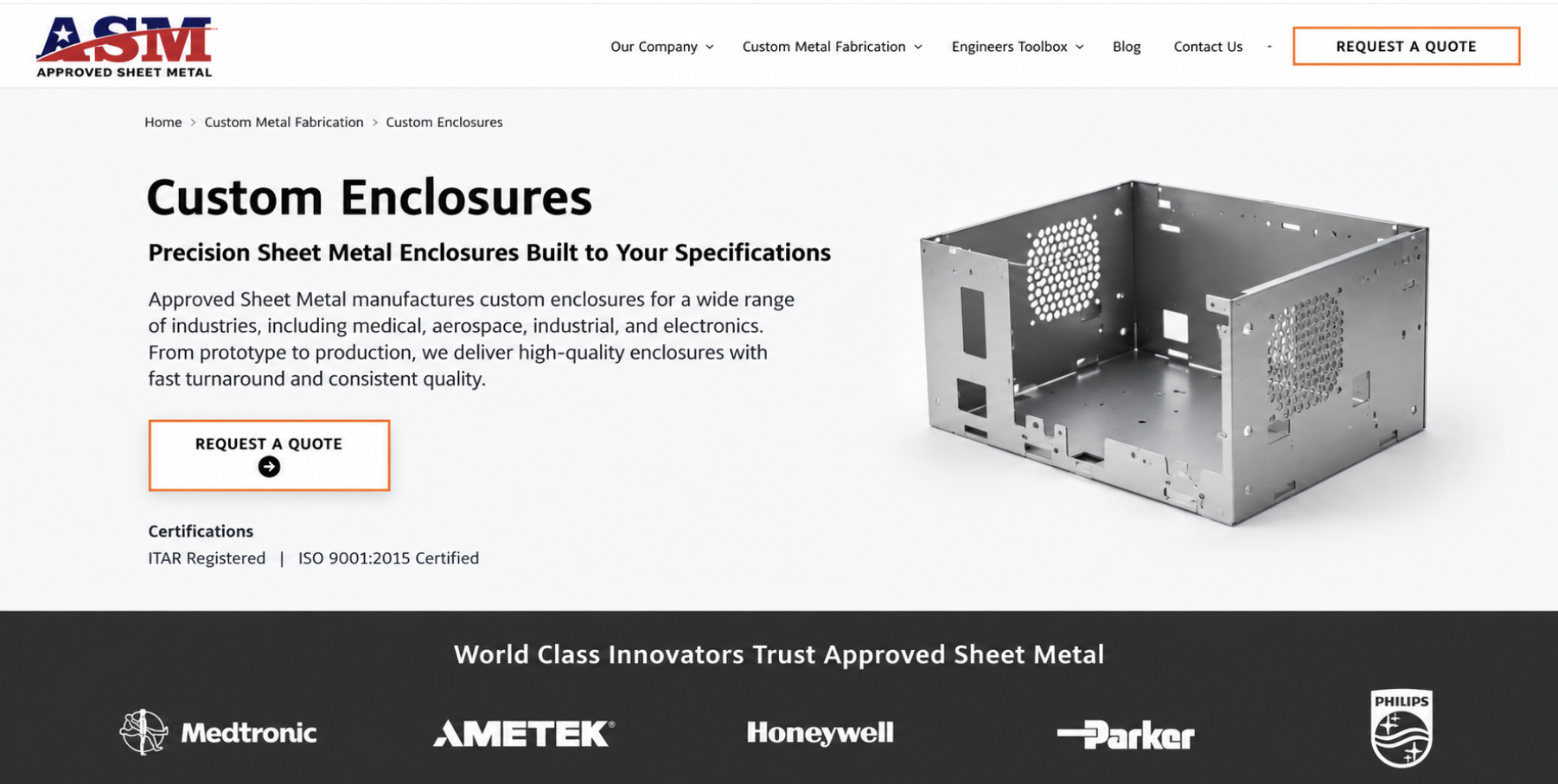
Approved Sheet Metal ranks sixth because its website performs exceptionally well on speed, accessibility, and trust signals. It is the fastest-loading site among the ten, and its certifications are easy for buyers to verify. The main limitation is product information: the pages do not provide enough technical detail for buyers to evaluate manufacturing capabilities before requesting a quote.
Performance
Performance is the site’s clearest strength. Its Largest Contentful Paint reaches 1,563 milliseconds at the 75th percentile in CrUX field data, the fastest result among the ten and firmly within the FAST range under Core Web Vitals.
The site pairs that speed with a clean, well-structured layout, so buyers can move through the content without unnecessary friction.
Accessibility
Accessibility is similarly strong. An axe scan returns zero critical rules and at most one serious issue, placing Approved Sheet Metal among the strongest interfaces in the ranking.
That means buyers using assistive technology face relatively few barriers when navigating the site or reaching key conversion points.
Certifications and trust signals
The site also makes important supplier credentials visible.
Public trust signals include:
ISO 9001
ITAR
For buyers in defense-adjacent or regulated industries, making these credentials easy to find helps with early-stage supplier qualification.
Product specifications
The weakest area is the depth of technical information on the product pages.
Pages for custom manufacturing services rely primarily on descriptive marketing content rather than structured engineering data. Buyers cannot easily find important details such as:
supported dimensions and size ranges
material options and gauges
manufacturing tolerances
thickness ranges
production and fabrication limits
other measurable capability constraints
Some dimensional information appears elsewhere on the site, such as in the tooling library, but it is not integrated into the main product or service pages where buyers are evaluating whether the manufacturer can handle their requirements.
Without this information, an engineer or procurement team cannot fully qualify the supplier from the website alone and may need to contact sales simply to establish basic technical fit.
Quote path
The quote path is relatively straightforward, using an 11-field form.
The larger issue is what happens before that form. A buyer is more likely to submit an RFQ when the product or service page has already confirmed that the manufacturer can meet the basic requirements of the job.
Without sufficient specifications, the site asks buyers to move into the quote process before they have enough information to qualify the supplier.
Final score
Approved Sheet Metal earns 73.4 out of 100 in our 79-site research.
Its speed, accessibility, and visible certifications create a strong foundation. The main opportunity is to bring the same level of clarity to its product and service pages by adding structured dimensions, materials, tolerances, and manufacturing capability data. Dana, ranked seventh, provides more concrete product specifications but introduces more friction in the quote journey.
7. Dana
Dana ranks seventh because its website combines strong accessibility with detailed technical product information and a broad set of visible certifications. Buyers can evaluate products and verify supplier credentials directly on the site, but the experience is weakened by average page speed and a generic contact path.
Accessibility
Accessibility is Dana’s strongest area. The site returns zero critical axe violations and only two serious issues:
color-contrast
nested-interactive
That places Dana among the cleanest interfaces in the ranking and makes key product information easier to reach for visitors using screen readers or keyboard navigation.
Product specifications
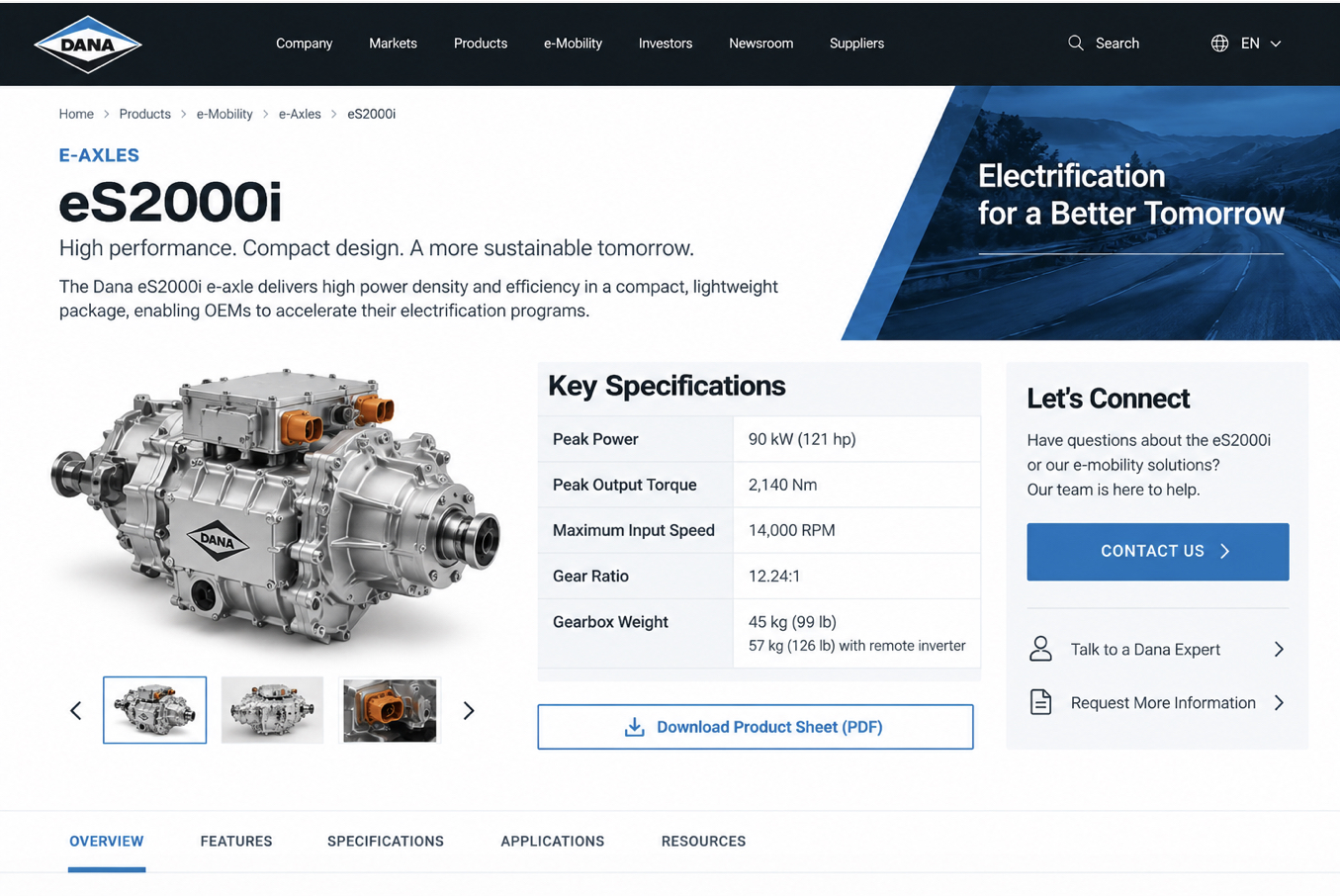
Dana’s product pages also provide the type of engineering information buyers need to evaluate whether a component fits their application.
The pages include:
power and performance ratings
torque and speed ranges
component dimensions and weights
load and vehicle compatibility ranges
configuration-specific technical data
measurable operating limits
This gives engineers and procurement teams enough information to assess product suitability before contacting sales, rather than relying on general marketing descriptions.
Certifications and trust signals
Dana also makes a broad set of quality and compliance credentials visible.
These include:
IATF 16949
ISO 9001
ISO 14001
ISO 45001
ISO 13485
For automotive and other regulated buyers, this gives the site a strong supplier-qualification layer alongside the technical product information.
Performance
The first weakness is page speed.
Dana’s Largest Contentful Paint measures 2,999 milliseconds at the 75th percentile of real Chrome traffic, placing it in the AVERAGE range under Core Web Vitals.
That is noticeably slower than the fastest sites in the ranking, so buyers wait longer before reaching the technical information that gives the product pages their value.
Quote path
The second weakness appears when a buyer is ready to make contact.
The product pages do not provide a product-specific quote path. Instead, the available call to action leads to a generic 38-field contact form that does not preserve the product context.
That breaks the connection between research and inquiry. After identifying a relevant product, the buyer has to reintroduce that context manually rather than carrying it directly into the sales request.
Final score
In our 79-site research, Dana earns 72.2 out of 100.
Its accessibility, detailed product specifications, and visible certifications create a strong research experience. The main limitations are average page performance and a contact flow that does not preserve product context. ACE, ranked next, faces a similar performance challenge but provides a more direct product-level quote path.
8. ACE (American Control Electronics)
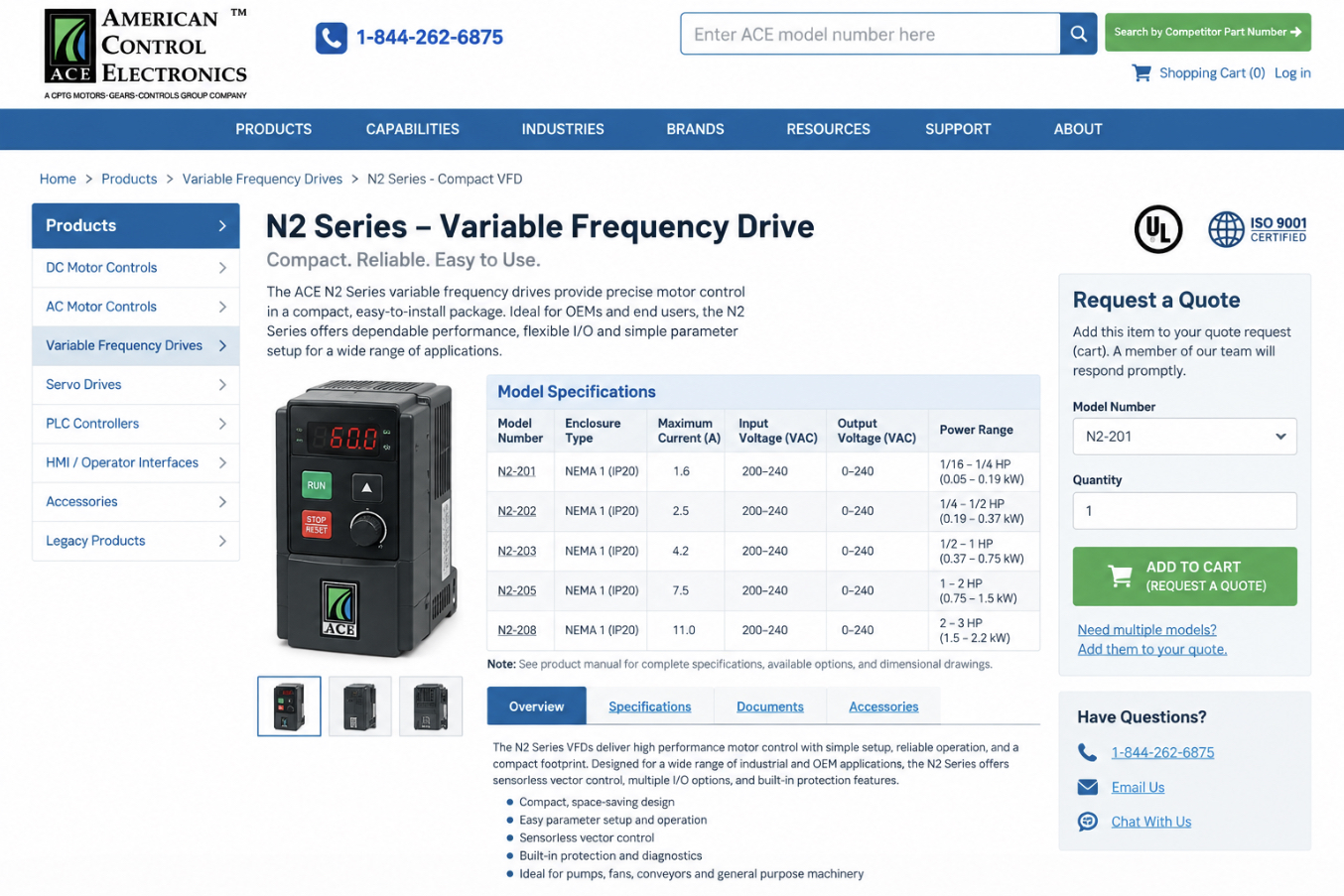
ACE ranks eighth because its website connects detailed product information with one of the most direct quote paths in the ranking. Buyers can review model-level specifications and move into a product-specific request without losing context.
Product specifications
ACE organizes its product pages around structured model-level technical data rather than general marketing descriptions.
Buyers can find information such as:
model numbers and product variants
enclosure types
current and voltage requirements
power and performance ranges
configuration-specific technical specifications
This makes it easier for engineers to compare models and determine which option fits an application before contacting sales.
Quote path
The quote path is one of ACE’s strongest features.
From the same product page, a buyer can add the selected product directly to the request flow through a form that asks for just one field. The product context stays attached throughout the process, rather than sending the buyer to a generic contact form.
That creates a short transition from technical evaluation to inquiry and removes the need to re-enter information the site already knows.
Certifications and trust signals
ACE also makes important supplier credentials publicly visible:
ISO 9001
UL certification
These give controls engineers and procurement teams an immediate way to verify basic quality and compliance requirements during product research.
Performance
Performance is less competitive.
ACE records a Largest Contentful Paint of 2,797 milliseconds at the 75th percentile of real-world traffic, placing the site in the AVERAGE range under Core Web Vitals.
That does not make the product pages unusable, but it creates more delay than the faster sites higher in the ranking.
Accessibility
Accessibility is the more significant weakness.
An axe scan returns one critical issue:
aria-required-children
It also returns two serious issues:
color-contrast
nested-interactive
These problems can interfere with how page controls are interpreted or operated through assistive technology, creating barriers that sighted users may not encounter.
Final score
ACE earns 72.1 out of 100 in our 79-site research.
Its strongest feature is the connection between structured product specifications and a short, product-aware quote path. The main weaknesses are average page speed and accessibility issues that make the experience less consistent across users. QC Conveyors, ranked next, provides even deeper model-level specifications but introduces more friction at the quote stage.
9. QC Conveyors
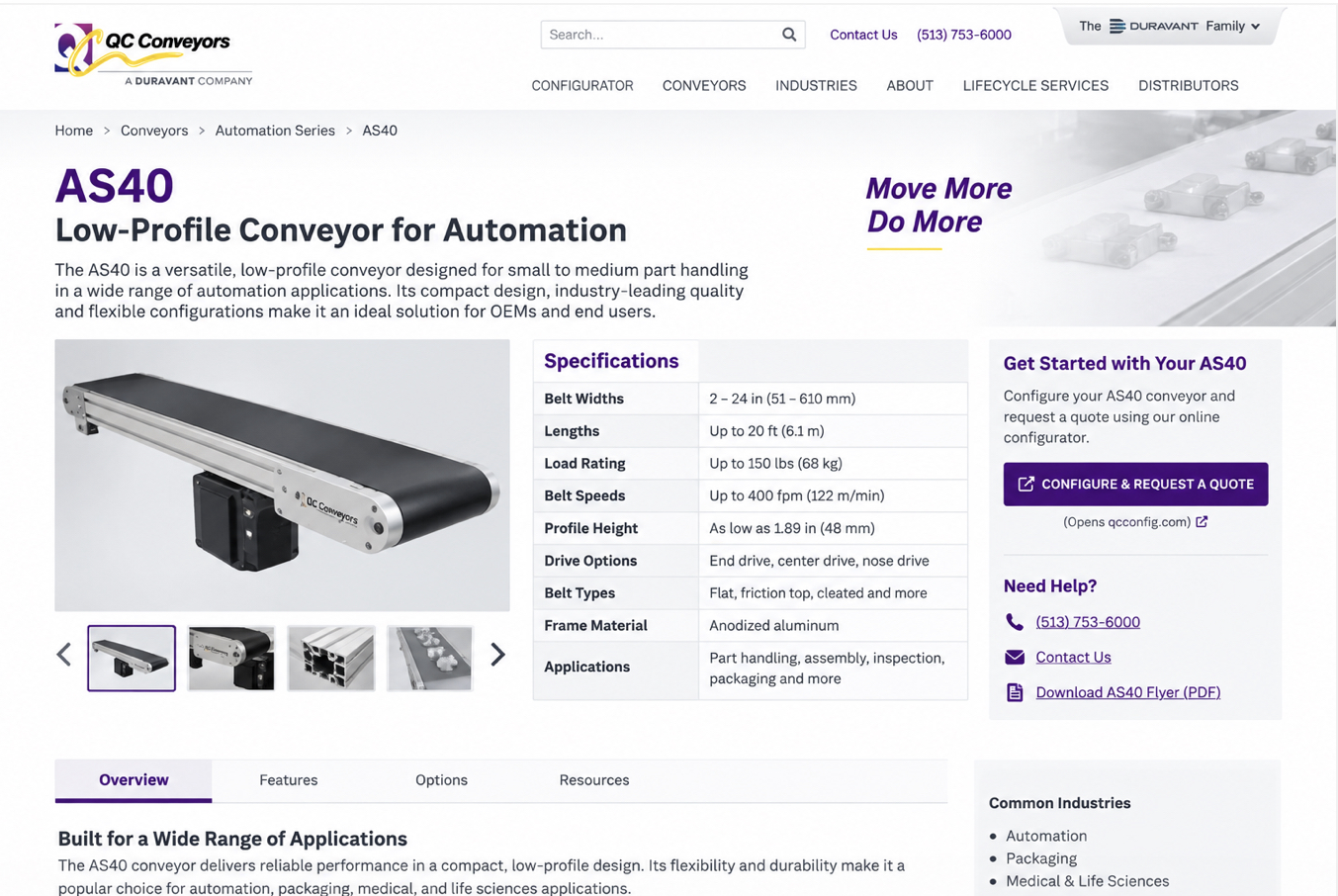
QC Conveyors ranks ninth because its product pages provide unusually detailed model-level information. Buyers can evaluate whether a conveyor fits the technical requirements of a project directly on the site, but the quote journey does not preserve that context.
Product specifications
QC Conveyors provides one of the strongest specification structures in the ranking.
Individual model pages include the types of information engineers need to compare options and confirm technical fit, including:
available size and dimension ranges
load capacities
speed ranges
profile and clearance measurements
model-specific configuration limits
detailed dimensional data
This allows a machine designer to assess whether a conveyor fits the required space, load, and operating conditions before contacting sales.
Performance
Performance is mixed.
The site records a strong lab performance score of 99 out of 100, while real-world Largest Contentful Paint reaches 2,587 milliseconds at the 75th percentile, placing it in the AVERAGE range under Core Web Vitals.
The pages remain usable, but field performance is not as strong as the synthetic test suggests.
Quote path
The main weakness appears when a buyer is ready to request a quote.
The quote call to action does not carry the selected model into a product-specific request. Instead, it sends the buyer to the separate qcconfig.com configurator, where the context built on the product page is not preserved.
That creates a disconnect between product evaluation and the commercial step. After confirming technical fit, the buyer has to establish the product configuration again rather than continuing from the page they were already using.
Certifications and trust signals
Trust signals are also relatively limited.
The site publicly shows NSF certification, but it presents fewer visible third-party certifications than the higher-ranked manufacturers in the study.
For procurement teams, that means the technical product information is strong, while supplier qualification may require additional verification outside the page.
Final score
QC Conveyors earns 72.0 out of 100 in our 79-site research.
Its biggest strength is the depth and structure of its model-level specifications. The main limitations are a quote path that breaks product context and relatively limited public certification visibility. PAC Machinery, ranked tenth, shows a similar pattern: strong product information paired with a weaker conversion path.
10. PAC Machinery
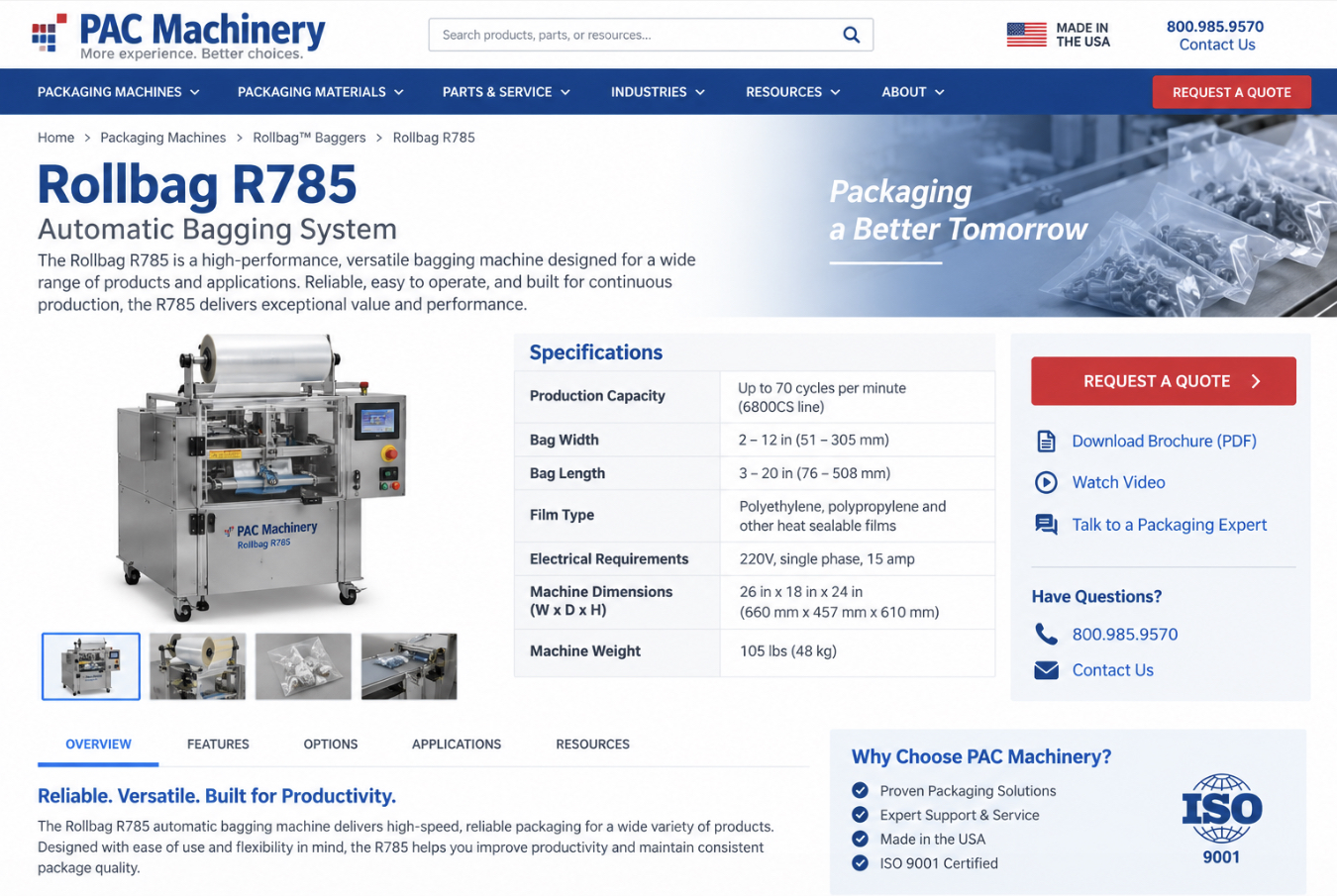
PAC Machinery sits tenth, the lowest of the ranked ten, and still ahead of every one of the other sixty-nine manufacturer websites in the benchmark. It ranks on two real strengths. The first is deep bagger spec tables: a Rollbag R785 product page publishes production capacity (up to 70 cycles per minute on the 6800CS line), bag-width and bag-length ranges (bag width 2 to 12 inches / 51 to 305 mm, bag length 3 to 20 inches / 76 to 508 mm), electrical requirements (220V, single phase, 15 amp), and hard dimensions: 26 inches wide by 18 deep by 24 high (660 by 457 by 610 mm), 105 lbs (48 kg).
That depth lets a packaging engineer confirm a machine fits a line before any contact. Second is certification: PAC Machinery publicly shows ISO 9001, the core quality standard a procurement team looks for first.
Three faults keep PAC Machinery at the bottom of the ranking. Performance is the softest of the ten, and the weakness sits in the lab diagnostic, which comes back at 48 out of 100 on render-heavy pages. Real-user Largest Contentful Paint actually lands in the FAST band at 2,483 ms (about 2.5 s), so the field experience holds up while the synthetic diagnostic flags the weight. Accessibility is the next problem: one critical axe rule, button-name, leaves a control with no accessible label, and three serious rules follow it. And the quote path undercuts the strong spec pages: both “Request A Quote” buttons on the Rollbag R785 page open a generic Contact Form 7 form, not a request carrying the machine the buyer was configuring. PAC Machinery earns a 71.7 in our research, the tenth-best result of seventy-nine.
Across the full set, the same handful of behaviors separates these ten from an average manufacturer website, and the same gaps recur wherever a site falls short of them.
What Do the Best Manufacturer Websites Have in Common?
The best industrial websites share five habits at once: fast Core Web Vitals, product specifications published in full, a quote path that begins at the product, public certifications, and clean accessibility. Ranked on real website performance, the top scorers carry that same short list, the industry-standard UI/UX and development conventions a technical buyer already expects from a serious supplier. What sets the ten best manufacturing websites apart is that they carry every one of those conventions at once, not a lucky two or three.
Five behaviors recur across the leaders:
Fast Core Web Vitals. The page loads before a buyer gives up on it. Scot Forge renders its main content in 1.65 seconds and Approved Sheet Metal in 1.56, fast enough that a procurement team never sits watching a specification table paint in.
Product specifications, published in full. Each site publishes real specification blocks and downloadable datasheets on the product page itself, so a buyer verifies tolerances, materials, and dimensions without opening a support ticket.
A quote path that begins at the product. The request-for-quote starts on the exact part in view rather than a catch-all contact form. Sierra Circuits provides an instant online quote; ACE provides an add-to-cart order path.
Certifications shown in the open. Each site shows its certifications publicly, so a procurement team confirms ISO 9001 and the niche standards that matter before the first phone call, not after it.
Clean accessibility. The markup reads cleanly to assistive technology and to search crawlers alike. Dana returns zero critical axe rules and only two serious ones, and Scot Forge clears its scan just as cleanly, with no critical faults to block a screen reader.
None of this is guesswork. The same five habits rise to the top of our own US Manufacturer websites performance research, a study that measured 79 US manufacturer websites against these exact criteria. The leaders did not earn their standing on one standout feature. They earned it by doing all five, and that combination is rarer than it should be. Most manufacturer websites manage one or two of these habits and stop there.
Where Are Most Manufacturer Websites Weakest?
Most manufacturer websites are weakest at the first thing a buyer registers: speed. The failures cluster there, and they compound from there. Beneath the top ten, the ordinary manufacturer website tends to break in the same four places, and each break costs a lead, a verification, or a shortlist spot.
The field-wide gaps, measured across the same 79 sites, cluster in the same handful of places:
Field-wide gap
Measure (of 79 sites)
Why it costs a lead
Core Web Vitals fail
59 of 79
The largest element on the page paints too slowly, so the buyer waits on a sluggish load, frequently long enough to leave before a single product renders.
No product-specific quote path
63 of 79
The request-for-quote dead-ends in a generic contact form that strips out the part context, and that form quietly suppresses the leads the site exists to capture.
No downloadable datasheet
24 of 79
A buyer who cannot download the numbers cannot verify a part against a drawing, so the specification either moves to email or stalls; only 55 of the 79 sites publish one.
Certifications hidden from public view
11 of 79
With no ISO 9001 or industry standard on display, a procurement team cannot confirm trust before making contact, and an unverified supplier drops off the shortlist.
Field average score
63.9 out of 100
That is the baseline the best manufacturing websites clear; the ten leaders sit well above it, while the typical manufacturer website settles right around the middle.
Fixed in order, speed comes first. Core Web Vitals fail the widest, at 59 of 79, and a fast page is both the cheapest repair and the one the others depend on, since a datasheet, a quote form, and a certification badge all have to load before any of them can work. The quote path follows, because that generic form is where a hard-won visit loses the lead outright.
How IT Monks Designs Manufacturer Websites?
IT Monks designs manufacturer websites by repairing the field’s four weakest points in the order that returns the most qualified inquiries first:
Product-level quote path. Implement a request-for-quote or add-to-cart action on the individual product page, beside the specification block, so an inquiry starts from the exact part a buyer is looking at rather than a single generic contact form.
Core Web Vitals. Measure Largest Contentful Paint at the 75th percentile and fix the render path until the page loads under the passing threshold on the phones a plant engineer actually browses on.
Public certifications. Provide the quality and compliance credentials openly on the product and capability pages, where a procurement team weighs supplier fitness, instead of leaving them inside a downloadable file alone.
Downloadable datasheets. Deliver a datasheet, drawing, or specification document on every product, so an engineering team can specify a part without waiting on a sales call.
Those four repairs sit inside a larger build standard. The best manufacturing website design, judged against real website behavior, prioritizes the five properties that separate a best-in-class site from an ordinary one: real product specifications an engineer can act on, fast Core Web Vitals that hold under mobile load, a product-level quote path that opens the conversation at the point of interest, public certifications that answer the supplier-fitness question, and accessibility that keeps the catalog usable for every buyer. The agency builds each to industry-standard UI/UX and development consensus, tests it against the same measurements the strongest sites clear, and implements the fixes in the order that returns the most qualified inquiries first.
A manufacturer planning that rebuild works with IT Monks on manufacturing web development that treats the specification catalog, the page speed, and the quote path as one connected system rather than three separate projects. The endpoint stays fixed throughout: a manufacturer website that converts technical buyers into qualified leads, because the depth of the specifications, the speed of the pages, the presence of the quote action, the visible credentials, and the accessible catalog all direct the procurement team toward the same next step, the request for quote.
 | updated:





 ChatGPT
  Claude
  Grok
Grok  Gemini