- Expertise
Expertise That Drives Results
Explore our specialized services, tailored solutions, and industry expertise to elevate your digital presence. From custom WordPress development to seamless integrations, we build high-performing websites that deliver impact.
Solutions- Booking System Integrations
- Headless & REST API WordPress
- Hubspot Integration
- Enterprise WordPress
- Website Migration
- Internal Collaboration Platforms
- External Communications Hubs
- Work
- About
- Proof
- Contact
Learn more
 | updated:


What Is MySQL

All websites that require user accounts, serve dynamic pages, or conduct any sort of transactions depend on some system for storing and organizing structured data according to known patterns and retrieving it when requested. MySQL solves this problem for a large portion of the internet through serving as the database engine for websites using WordPress, e-commerce sites, and other customized web applications with millions of write-read cycles each day.
The MySQL software has distinct elements across several different layers. It structures information according to certain patterns, builds concrete databases in the form of schemas, tables, and entries contained within them and stored to disk to record persistent information for an application’s operation, provides a server process listening for connections and executing queries, and combines this with clients to perform these actions.
The operation of the server requires a variety of management tasks. These include administrative actions like maintenance and performance tuning, backup and recovery, monitoring for faults, and more. The MySQL software has an established license as open source, differs from the query language SQL with respect to naming, and has tight integration with the WordPress platform as the primary database system.
MySQL was developed because web applications required a reliable and consistent way to structure their information into tables, define relationships among them, and produce accurate responses to queries made by the application.
MySQL as a Relational Database
MySQL is an open-source relational database management system (RDBMS). As such, it is designed around a model in which data is arranged into tabular structures, wherein these tables are interrelated based on certain relationships. In other words, the basic principle of the relational database model was proposed by E.F. Codd in his 1970 paper “A Relational Model of Data for Large Shared Data Banks”. Written while working at IBM, the article introduces the concept of the relation (a set of data organized in rows and columns). According to Codd, each row represents a data record, and each column represents a data field.
MySQL, as mentioned above, is a database management system (DBMS). To make it clear that it is a DBMS and not a programming language, it is important to note that a programming language is not even a category within which MySQL can be found. This statement is needed because people sometimes ask whether MySQL is a programming language and create search queries accordingly. It is easy to see that the relationship between a DBMS like MySQL and programming languages is a complementary one in which application code written in a certain programming language submits queries in SQL to the database managed by MySQL, and MySQL processes these queries, returning the needed results.
As already mentioned above, SQL is the querying language used in MySQL. While MySQL is a database software (i.e., a DBMS) in which data is stored and retrieved using SQL queries, SQL is a standardized (as defined in ISO/IEC 9075) language for querying relational databases that is used, for instance, in Oracle DBMS, MariaDB, PostgreSQL, and Microsoft SQL Server, amongst others. Again, the point is that MySQL is only one of the possible implementations.
MySQL is a database software created initially by Michael Widenius and David Axmark, currently developed and maintained by Oracle Corporation. Currently, there are long-term support releases of version 8.4 and the innovation releases of MySQL 9.x.
Finally, since MySQL is the database software, it implies that there is a particular architectural approach underlying it, which manifests itself through the data structures used by MySQL in storing data.
MySQL Database
A MySQL database consists of a set of schemas, which, in turn, contain tables, all created and maintained by the MySQL server process. By “MySQL database” we mean the data structure, tables, rows, and schemas on disk, not the MySQL server itself, which is the process reading and writing that data structure.
The same MySQL server process may have several databases open at once. A WordPress database is one such instance, typically dedicated to a single WordPress site. Every database includes tables containing rows of records having columns, thus forming a relational database architecture with its tables, keys, and schemas, but realized in a concrete structure. Such schemas provide an organizational way to logically divide a set of tables on a single server for unrelated sets of applications or users.
A storage engine is responsible for data physical storage. The default InnoDB engine handles physical data placement, indexing, transactions, and crash recovery, while MyISAM used to be the default before and is still available as an engine, but doesn’t include transaction management or data crash recovery. No matter which engine is used, the actual engine works behind SQL queries from applications; it translates logical data requests into physical disk activities.
An application uses a MySQL database with the help of an SQL query sent to the server. Client software opens a connection to the server, executes an SQL query, and then receives result set(s). The server processes an incoming query by accessing the requested database and performing operations defined in the query itself as well as according to access control settings. This way, any MySQL-enabled dynamic web app communicates with a MySQL database: connection, query, processing result set, and serving data to a user.
A MySQL database with its tables, schemas, InnoDB storage engine, and SQL queries works identically in the cloud environment.
MySQL Cloud Database
A cloud-hosted MySQL database is one managed by a cloud service provider and running on its remote infrastructure. However, there is no difference between the architecture of the database, whether hosted by the provider or not. The same tables, schemas, and storage engines are being used in all cases, regardless.
Amazon, Google Cloud, Microsoft Azure, and Oracle all offer a Managed MySQL database service in their cloud infrastructures. That means deploying MySQL on a cloud platform as opposed to managing a MySQL database using your own server and hardware.
When managed by the cloud service provider, MySQL is automated for maintenance, including backups, scaling, patches, and high-availability configuration. That is all taken care of by the cloud infrastructure automatically, and all while still maintaining the MySQL database architecture.
Regardless of whether you manage your own MySQL database or use the one managed by the cloud service provider, the MySQL database server powers both scenarios.
MySQL Server
MySQL server is the mysqld daemon; it is a background process responsible for all interactions with the connected client regarding every single operation in the database. Clients connect to this server to query data. While the database is a structure with tables, rows, schemas, and other structured elements of information, the server is a program (software process) that allows creating, accessing, modifying, and securing information within this database. Starting as a background process, MySQL server is available through a certain port of the computer network or a Unix socket file.
By default, MySQL server is listening on port 3306 of your computer network. Whenever you try to access the database via a client application, the server checks your credentials using its own internal user-privilege system and grants you access. Once your connection is validated, it gets its own thread assigned to handle requests. MySQL server allows for managing several different databases at once, meaning that several schemas of different applications can be stored in one instance of the server without the need to install several of them.
Database server MySQL uses external components called storage engines for data storage. While MySQL server takes care of establishing connections, query parsing, and query optimization, InnoDB, the current default storage engine for MySQL databases, takes care of physical operations such as read-write access to the hard drive. The separation is important, as it makes it possible for the server and the storage engine to have their distinct tasks without the need to implement the same functionalities in both programs.
Despite the similarities between MySQL database and MySQL server, there should be no confusion here. It is essential to know that MySQL server is a background process and MySQL database is the actual structure containing all the tables, rows, and index structures. Both cannot work without each other, while the MySQL client is a program initiating a dialogue between those two processes.
MySQL Client
MySQL clients are interfaces for communication between the client-side software and the MySQL server. They are used by developers or DBAs to communicate with a MySQL server using queries and statements written in the SQL programming language. These tools have a direct connection with the MySQL server since any action performed on a MySQL database has to be done through a client.
There are three classes of MySQL clients depending on how the access is made. The MySQL program is an interface that enables users to connect to the MySQL server and use a prompt for submitting their queries and reviewing the results. MySQL Workbench is another MySQL client program that comes with an attractive user interface. Developers or DBAs are provided with a single platform for designing database schemas, executing queries, and administering their MySQL servers. MySQL Connectors, which include the MySQL driver, enable developers to communicate with MySQL server databases through API calls from their languages. Such languages include PHP, Python, and Java.
The three types of MySQL clients follow the same procedure in their operations. A client connects to a MySQL server and uses a username and password for authentication purposes. Once authenticated, the client sends SQL statements to the server, and the server responds to these queries by sending back result sets. This process can be repeated several times until all operations are completed successfully. All actions performed by MySQL clients fall under MySQL database management.
MySQL Database Management
The concept of MySQL database management encompasses all activities that ensure the proper functioning of databases and the processes associated with their use, from user access control to survivability in the event of equipment failure. It includes all procedures implemented through a database management system that are carried out by the personnel involved in administering the system itself.
In a WordPress context, this also directly connects to operational tasks such as understanding how to back up the database in WordPress, since backup is one of the core safeguards within database management.
In particular, user administration is responsible for establishing the access policies for different users. MySQL privilege system allows defining very specific privileges for individual accounts, such as reading just one database or possessing full administrative rights to all databases available on the server. Data backup and recovery help protect user-generated data by regularly backing up and scheduling restoration procedures in case of loss. Query and connection monitoring make it possible to detect problems with performance in advance, thus avoiding bottlenecks for database-dependent applications. Finally, securing a MySQL installation not only means password protection but also encryption of client-server connections, limiting access by IP address, and monitoring privilege changes.
MySQL databases run applications used in many sectors, ranging from dynamic sites and e-commerce applications to custom applications. In fact, any database-driven site or application, which implies a need to maintain and operate user sessions, store information about users and their preferences, or about transactions, uses MySQL RDBMS due to its ability to handle reads and writes. Developing MySQL applications usually requires selecting a type of client, connecting to the server, and structuring requests depending on the schema contents.
There are three types of interfaces that can be used for executing the tasks described above. The first one is the web-based application, phpMyAdmin, designed to interact with the server from a browser. MySQL Workbench unifies a graphic query designer, schema builder, and MySQL server administration in a desktop application. Finally, working directly via command lines offers the best option for scripting purposes. All the mentioned interfaces use the same server and offer the same functionality; hence, the choice comes down to convenience.
MySQL relational database system, server process, client layer, and database management are governed by a particular model of licensing and governance.
Is MySQL Open Source
MySQL is open source and is distributed under the GNU General Public License (GPL). This allows individuals and organizations to use the code freely, which implies that one can download, use, modify, and redistribute the code of MySQL according to the terms of the GPL. As such, MySQL is referred to as a free database as opposed to simply being a downloadable database that comes at no cost.
The GPL license under which MySQL runs is not the only license used for the distribution of MySQL. It has been released in two different ways: as the MySQL Community Edition and the MySQL Enterprise Edition. While the former is an open source database and hence can be downloaded using GPL from the MySQL official website, the latter is a commercially licensed product by Oracle Corporation that includes advanced monitoring options and support services.
MySQL was developed in 1995 by Michael Widenius and David Axmark, who created it as a relational database management system optimized for running applications on the World Wide Web. In 2008, Sun Microsystems acquired MySQL AB, the company behind the development of MySQL. Oracle Corporation acquired Sun Microsystems in 2010, thus making Oracle the owner of MySQL. MariaDB is the branch forked out of MySQL after the acquisition by Oracle Corporation.
As an open source database and GPL-licensed product owned by Oracle Corporation, the licensing and ownership issues about MySQL are clear enough. Nevertheless, MySQL causes another type of confusion due to its similarity to SQL.
MySQL vs SQL
MySQL is a software product, a relational database management system that uses SQL as its query interface to store, organize, and retrieve data. SQL is a query language, a standardized syntax codified as the ISO/IEC 9075 international standard that defines how users and applications interact with relational databases. The two share a name fragment but are different things.
The difference between SQL and MySQL is the difference between a language and a tool that speaks it. SQL defines the grammar: the commands, operators, and clauses that describe what a relational database should do with its data. MySQL implements that grammar inside a working server process, the mysqld daemon, where SQL statements are parsed, optimized, and executed against real tables held in storage engines. SQL existed before MySQL and exists independently of it. The ISO/IEC 9075 standard defines SQL as the universal query language for relational databases, and every major RDBMS implements its own dialect of that standard.
| Aspect | MySQL | SQL |
|---|---|---|
| Type | Relational database management system (software) | Structured Query Language (SQL) |
| Purpose | Stores, organizes, and retrieves data in databases | Defines, manipulates, and queries data in relational databases |
| Examples of peers | MariaDB, PostgreSQL, SQL Server, Oracle Database | Used by all relational database management systems |
| Creator / Standard | Created by Widenius and Axmark; maintained by Oracle Corporation | ISO/IEC 9075 international standard |
PostgreSQL, MariaDB, SQL Server, and Oracle Database also use SQL as their query language. Each implements the ISO standard with its own extensions and dialect differences, but the underlying grammar is shared. SQL is the common interface; MySQL is one product in a larger class of software that relies on it.
MySQL serves as the default database backend for WordPress, the content management system that powers 43.5% of all websites as of April 2026, according to Q-Success’ W3Techs “Usage Statistics of Content Management Systems” survey.
MySQL for WordPress
The default database backend in WordPress is MySQL. Every WordPress installation automatically creates a MySQL database at install time alongside the WordPress file and directory structure, and any action made while browsing, administering, and updating the content passes through the database, which is the storage layer for storing information permanently in the application.
All WordPress database contents consist of the operational surface of the CMS. Published and drafted posts, custom post types, comments, accounts, site-wide configuration values, and metadata are all stored in different tables of the MySQL database used in the application. The default table prefix in WordPress applications is “wp_”, hence some tables such as wp_posts, wp_options, wp_users, and wp_postmeta store published content, configuration values, account data, and post metadata, respectively. The ability of the WordPress application to build and retrieve web pages through WP_Query and data scattered in MySQL is thanks to the table-and-key database structure that allows for relational database queries and management.
Aside from being compatible as a default database in WordPress applications, MariaDB also functions as an alternative MySQL database backend that can be used in WordPress. This is because MariaDB was forked from the same codebase as MySQL database; hence, both databases are compatible at the wire level and use the MySQL communication protocol. Many hosts that support MySQL also allow MariaDB in WordPress installations and vice versa, since both of them use the same communication protocol in their databases.
Therefore, WordPress MySQL is the data layer for all WordPress applications. It is an open source, relational database management system for organizing, querying, and storing data in tables managed by a dedicated server, and is governed by dual GPL and commercial licenses by Oracle Corporation. The open source relational database management system used for storing the posts, comments, accounts, and configuration of WordPress websites is what is referred to as the WordPress MySQL.
Some operations related to this include backup, migration, optimization, and repair of the database. These are administrative operations done to achieve specific tasks on a WordPress database.
More Articles by Topic
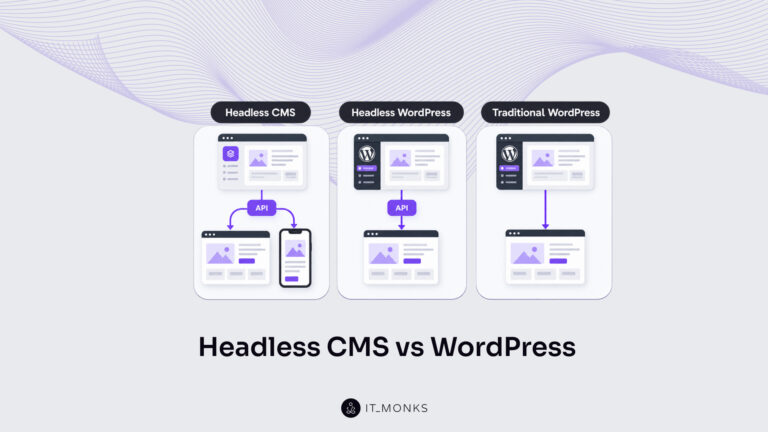
Headless CMS vs WordPress is a comparison of two choices made at once: an architecture choice between a coupled site…
Learn more 
The new campaign copy is approved. The ads go live on Monday, and the landing page they point to still…
Learn more 
Imagine a marketing team two days before a campaign launch. The copy is approved, the images are ready, and the…
Learn more Contact
Feel free to reach out! We are excited to begin our collaboration!
Don't like forms?
Shoot us an email at info@itmonks.com
Don't like forms?
Shoot us an email at info@itmonks.com

CEO, Strategic Advisor
Reviewed on Clutch
 ChatGPT
  Claude
  Grok
Grok  Gemini
 Send a Project Brief
Fill out and send a form. Our Advisor Team will contact you promptly!