Explore our specialized services, tailored solutions, and industry expertise to elevate your digital presence. From custom WordPress development to seamless integrations, we build high-performing websites that deliver impact.
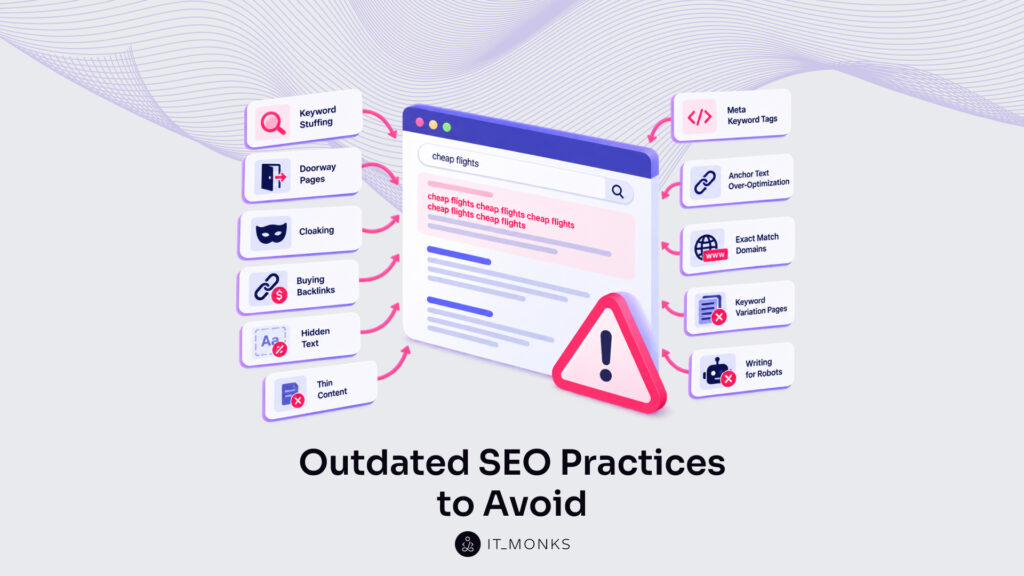
Outdated SEO practices are deprecated tactics that once lifted search rankings and now work against them, which is why experienced site owners and marketers avoid them. The recurring ones span keyword stuffing, doorway pages, cloaking, buying backlinks, hidden text, thin content, meta keyword tags, anchor text over-optimization, exact match domains, keyword variation pages, writing for robots, and duplicate content. Every one is a method ranking systems once rewarded and have since learned to penalize. Marketers tend to file them under a plainer label, the common SEO mistakes that outlive the algorithms they were built for.
Most of these tactics persist out of habit rather than strategy. A page optimized years ago may still run on methods that satisfied an older version of a search engine, untouched since the day it went live. Others spread by imitation, lifted from guides written for a version of search that no longer exists. The intent is seldom manipulation; far more often, it is neglect.
A single pattern holds the class together. A method that once pushed a page toward the top of results now drags it down, because search engines have learned to read the very signals they once rewarded as evidence of gaming. Knowing the common SEO mistakes to avoid matters more than collecting ranking tricks, since one deprecated tactic can quietly undercut months of legitimate work. Every outdated practice repeats that pattern: effective once, penalized now, and already replaced by a compliant method that modern SEO builds on instead.
Keyword stuffing is the most recognizable of them, the tactic most people name first when they picture SEO done the wrong way.
Keyword Stuffing
Keyword stuffing is the excessive repetition of a target keyword, crammed into body content, meta tags, and image alt attributes in an attempt to manipulate rankings. The definition holds across every surface where text can carry a phrase: a paragraph that names its keyword in every sentence, a meta description overloaded with variants, an alt attribute written for a crawler instead of describing the image. The versions share one intent. The words are placed to game a ranking system, not to inform anyone reading.
For a stretch of early search history, the tactic worked. Search engines counted keyword frequency as a rough proxy for relevance, so a page that repeated its phrase often enough could climb above better-written competitors. That era closed. Modern ranking systems read language much the way people do, and text engineered around repetition reads as exactly what it is.
The penalty now runs in the other direction. Stuffing keywords reduces readability, because sentences bent around a repeated phrase lose the rhythm and precision that hold attention. It lowers search visibility, since systems trained to detect over-repetition demote the pages that lean on it. And it draws manual and algorithmic penalties that can pull a page out of results altogether. A tactic built to raise a ranking now works against it on all three fronts.
That reversal is what makes keyword stuffing an outdated SEO practice rather than an aggressive but still viable one. Marketers avoid it not by rationing a phrase to some safer count, but by writing that earns relevance through meaning, placing a keyword where it belongs and its natural variations where they fit. The same failure repeats across the rest of the class, each remaining tactic another way of signaling to a machine what should have been written for a person.
Doorway Pages
Doorway pages, also called gateway pages, are low-value pages built to target specific keywords, rank for the queries those keywords match, and then redirect users to a different destination, offering no value of their own. As an outdated SEO practice, a doorway page in SEO exists for the ranking, not for the visitor: the result that appears in search and the page a visitor ultimately lands on are two different things. That split between the surface that ranks and the target hidden behind it is what marks the page as manipulative rather than genuine.
The mechanic is deliberate. A doorway page targets a narrow set of keywords with thin, purpose-built copy, claims a position for those terms, and then moves the visitor on through a redirect. A common doorway pages example is a batch of near-identical pages, each one tuned to a single city name or product variant, all redirecting to the same commercial page. The variants occupy rankings; they answer nothing.
Whatever ranking a gateway page gains this way is temporary, and the harm it does is not. Doorway pages harm user experience, because the visitor arrives expecting the content that ranked and is redirected elsewhere instead, and they violate search engine policies written to catch exactly this kind of concealment. Once the pattern is identified, the pages lose the positions they were built to win, leaving a set of low-value pages with no standalone purpose. Site owners retire doorway pages for that reason, treating them as an outdated SEO practice rather than a shortcut worth keeping.
Cloaking
Cloaking is the practice of serving different content or URLs to search-engine crawlers than to human users. In practice, cloaking in SEO comes down to a single address that resolves to two different versions: the tactic presents the crawler with one version, keyword-rich and tuned for ranking, and the human visitor with another version entirely. Cloaking in SEO depends on that split: one audience sees the page that ranks, the other sees the page that actually loads.
The goal behind cloaking is manipulation of rankings. By showing crawlers content they will reward and hiding the version real visitors get, the practice tries to win positions the honest page could not earn on its own. It is a concealment tactic in the plainest sense: it shows one thing and hides another, which places cloaking alongside the other hidden and misleading methods that trade user trust for a short-lived position.
Cloaking does not stay hidden for long. The mismatch between the crawler version and the user version is detectable, and once detected it draws a penalty: a ranking drop, or removal from the index altogether. That exposure, paired with the guideline violation it represents, is why cloaking remains one of the outdated SEO practices that site owners drop rather than attempt.
Buying Backlinks
Buying backlinks means paying for inbound links, or trading them in bulk through excessive link exchanges, to inflate a site’s authority artificially. As an outdated SEO practice, it belongs to the wider category of link schemes: manipulative arrangements built to manufacture ranking signals that a site never earned. Private blog networks run on the same logic. A private blog network is a cluster of sites owned or controlled by one operator and created for a single purpose, pointing links back at a target site to pass it ranking signals it never earned. Bought links, private blog networks, and excessive link exchanges all pursue the same shortcut, and a bought link is a bad link by construction, since its only reason to exist is manipulation rather than merit.
The shortcut no longer holds. Search engines detect the footprints these networks leave behind: shared ownership signals, near-identical templates, unnatural anchor distribution, and link velocity no organic profile would ever produce. Once the pattern is recognized, search engines penalize the site that bought the links, and in the harder cases they deindex it, pulling every affected page out of results entirely. A private blog network can hold authority temporarily, then lose months of visibility in one algorithmic pass. Volatility like that separates a manufactured link profile from a durable one, and it lands the tactic among the outdated practices rather than the current ones.
The compliant counterpart works in the opposite direction. Natural link building earns authority instead of purchasing it, so links arrive because other publishers reference genuinely useful work on their own initiative. Site owners avoid the penalty by abandoning the purchase altogether and building the kind of content other sites choose to cite.
Hidden Text
Hidden text conceals keywords inside a page so that users never see them while search engine crawlers still read every word. As an outdated SEO practice, it manipulates presentation rather than substance: the keywords are set in a font color that matches the background, or shrunk to a font size so tiny it disappears against the layout. The text sits in the markup, fully present to any crawler parsing the source, yet stays invisible to users looking at the rendered page. That gap between what stays invisible to users and what remains readable by crawlers is the whole mechanism.
Concealment is the shared logic across a small family of tactics. Hidden text runs on the same concealment principle as cloaking, which serves crawlers one version of a page and visitors another, and doorway pages, which funnel search traffic through content built only to be ranked and passed straight through. All three split what the search engine reads from what the visitor actually gets.
The tactic once worked because early parsers processed raw text without seeing how it rendered. That era is over. Search engines now render a page much the way a browser does, so keywords set in the background color or collapsed to an unreadable size are trivially detectable. What used to slip past a text-only parser now marks the page as deceptive, and search engines treat concealed keywords as a manipulation signal and demote or penalize the page. Concealing text no longer hides anything worth hiding, which is why site owners and marketers stop attempting it and count it among the outdated SEO practices.
Thin Content
Thin content is content that lacks depth, expertise, or real value for the visitor. As an outdated SEO practice, it names any page stretched to look substantial while offering almost nothing a site owner or marketer could act on, a shallow answer presented as a complete one. The defining failure is what the page lacks rather than what it contains: no depth on the subject, no genuine expertise behind the claims, and little value once a visitor lands on it.
Thin content is unlikely to rank well, because search engines now weigh depth and expertise when deciding what deserves visibility. Length is a signal here, not a rule. No magic word count turns a thin page into a strong one, and no target number is worth chasing, since a short page can be complete while a long page can still say very little. Coverage separates the two: whether the page addresses its subject with enough depth and expertise to satisfy the intent behind the query, not how many words it runs to.
The counterpart is comprehensive, valuable content built to serve the person who searches instead of filling space. That standard, unique and genuinely useful writing, is where the modern replacement for thin content is found, and it is the direction site owners move once they stop padding pages to hit an imaginary quota.
Meta Keyword Tags
The meta keyword tag is a hidden field where early sites once listed the terms a page hoped to rank for. Modern search engines rank pages by the intent behind a query, not by an exact keyword match counted somewhere in the code, and the tag stopped carrying weight the moment ranking shifted toward intent. Meta keyword tags provide no SEO value as a result. Stuffing that field with keywords does nothing for a page today.
The distinction matters, because not every meta element fell out of use. Meta titles and descriptions still influence click-through from the results page and remain worth writing carefully. The meta keyword tag does not share that role. As an outdated on-page practice, meta keyword tag optimization is best treated as something to stop doing rather than something to refine, and the strongest best practice for the tag now is to leave it empty. Site owners and marketers avoid wasted effort by ignoring it entirely and directing that attention toward content the search engine actually reads for intent.
Anchor Text Over-Optimization
Anchor text over-optimization means pointing inbound and internal links repeatedly at the same exact-match keyword phrase, and it belongs among outdated SEO practices rather than sound linking advice. Relevant, descriptive anchor text still retains its value. A link labelled with what a page genuinely answers helps search engines confirm what sits at the other end. Trouble starts with repetition. When almost every anchor pointing at a page carries the identical exact-match keyword, that uniform pattern reads as an attempt to manipulate rankings rather than describe a destination.
Over-optimization, in SEO terms, turns a helpful signal into a manipulative one. Exact-match anchors clustered too densely inflate a single phrase well past anything a natural linking pattern would produce, and once search engines register the manipulation, the anchor forfeits whatever relevance it once carried. Site owners sidestep the penalty by diversifying anchors toward varied, natural phrasing (branded mentions, partial matches, plain descriptive wording), so no single exact-match phrase dominates. Reliance on the domain name itself follows the same manipulative logic.
Exact Match Domains
Relying solely on a domain that exactly matches a target keyword is an outdated SEO practice. Exact match domains are domain names that contain the exact target keyword inside the address itself, regardless of the quality of the links or content behind them. Once, that keyword-in-domain arrangement was a real ranking advantage. It no longer provides one.
Search engines stopped rewarding the domain string years ago, because a keyword sitting in an address says nothing about whether the content answers the query behind it. Brandability and user trust carry the weight now: a name people remember, repeat, and click because they recognize it, not because it echoes a search term. A memorable brand outweighs a keyword wedged into the domain. Marketers build toward that identity (a distinct, trustworthy name), and avoid treating the domain as a ranking advantage in itself. The same instinct to multiply keyword-matched assets shows up one level down, in the pages themselves.
Keyword Variation Pages
Keyword variation pages are separate pages built for each slight variation of the same keyword: one page for “affordable web design,” another for “cheap web design,” a third for “low-cost web design,” all covering a single topic. Creating a distinct page per variation is an outdated SEO practice. These near-duplicate pages fragment one search intent across several thin addresses, and none of them earns a distinct ranking anymore, because search engines read them as versions of the same query rather than separate topics.
Modern SEO consolidates the variations instead. A single comprehensive page, written to answer the underlying user intent and to cover the semantic keywords surrounding it, absorbs what a dozen scattered variation pages once tried to split apart. Depth on one page serves user intent more precisely than breadth across many, and it keeps the topic from diluting across competing addresses. Optimizing that page for a person’s underlying goal, rather than the surface wording, matters far more than owning every phrasing of the query.
Writing for Robots
Writing for robots means producing copy tuned only for keyword density and technical signals, with no regard for how an actual person reads it, writing for crawlers, not users. It counts as an outdated SEO practice because content built to satisfy an algorithm rather than a human reads as poor-quality, and search engines have learned to devalue exactly that kind of text. Forcing a target phrase to a precise density, packing exact-match terms into every paragraph, shaping sentences around what a crawler tallies rather than what a reader understands. Each choice optimizes for the machine and degrades the experience of the person the page is supposed to serve.
Keyword-density-first writing results in text that no one wants to finish, and mechanical prose earns no ranking however carefully its keyword ratios were engineered. Content written for users first, clear and genuinely useful, is what holds value now. A page optimized for crawlers over people is a content-quality failure, and that same failure in its most literal form leads to publishing content that merely repeats what already exists elsewhere.
Why Is Duplicate Content an Outdated SEO Practice?
Duplicate content is copied or spun material that adds no value, which is exactly why it counts as an outdated SEO practice. The term covers two habits: text copied word for word from other sites, and article spinning, where existing content is rephrased just enough to look original and then reposted as new. Neither version earns the ranking it seeks. Both involve exploiting search engines rather than adding real information for the visitor who opens the page.
Article spinning is the quieter of the two, because it disguises the copying. It rephrases existing content and reposts it as new, so the wording changes while the substance stays borrowed. Duplicate content once helped rankings; today it hurts them. Search engines detect the overlap and discount the page, and systematic scraping or spinning risks a manual spam action. That penalty risk is why the tactic no longer belongs in a serious strategy. Black hat SEO is a class of shortcuts built to manipulate rankings without adding value, and duplicate content falls under it.
The heavier damage comes after that, in what search engines actually do once they flag the overlap.
Consequences of Outdated SEO Practices
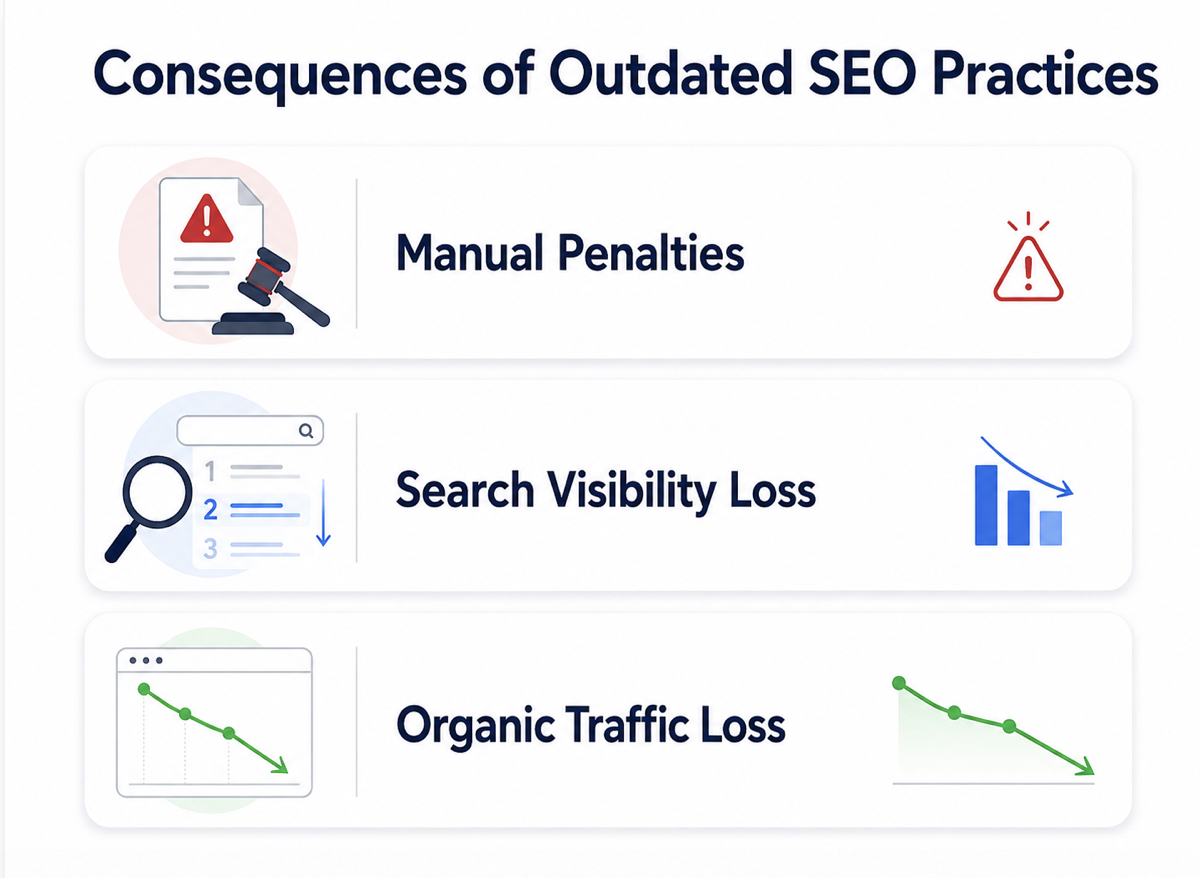
The consequences of outdated SEO practices are the search-side outcomes that follow once a site keeps using tactics search engines have already moved against. Three of those outcomes come as a set: manual penalties, search visibility loss, and organic traffic loss. Outdated SEO practices lead to all three together, not one at a time, because the same guideline breach that draws a penalty is also what pulls the site down in the results and drains the visitors those results used to send.
What makes these practices tempting is the early payoff. Keyword stuffing, cloaking, purchased links and the rest can deliver a short-term ranking gain that looks like progress. That gain rarely holds. These tactics result in penalties, and the harm outlasts the benefit by a wide margin. Site owners and marketers who trade a durable position for a quick gain usually end up with neither. The damage breaks into an action a reviewer issues by hand, a measurable drop in how visible the site stays, and the matching decline in unpaid visitors that visibility used to bring.
Manual Penalties
A manual penalty is an enforcement action that a human reviewer at the search engine applies to a site after judging it in breach of the published guidelines. Unlike an algorithmic action, which the ranking system applies automatically, a manual penalty reflects a person’s decision: the site gets flagged, reviewed, and demoted or removed by hand. Outdated SEO practices put a site in front of that reviewer in the first place. Recovery from a manual penalty is slow and difficult. The offending practice must be removed, a reconsideration request filed, and the search engine must re-examine the site before any standing is returned. Weeks or months can pass before the site regains its former position.
Search Visibility Loss
Search visibility loss is a drop in how often and how prominently a site appears across search results. Outdated SEO practices cause that drop directly: as rankings fall, the site slips off the first page for terms it once held, then stops surfacing for many of them at all. Visibility is cumulative. A page that ranked across a broad spread of related queries loses that spread position by position, so the decline compounds rather than staying contained to one keyword. What remains is a site that still exists in the index yet is, in practice, hard to find.
Organic Traffic Loss
Organic traffic loss follows visibility loss as its direct effect: once visibility falls, fewer people arrive through unpaid search results, because there are simply fewer positions left for them to reach. Organic traffic is the visitor flow a site earns without paying for placement, and it depends entirely on ranking where searchers already look. Lost rankings lead to lost sessions, lost leads, and lost revenue that no amount of the original shortcut can win back. Taken together, the reviewer’s action, the visibility decline and the traffic drop are the damage that deliberate manipulations leave behind. The same damage follows from what a site neglects and from mistaken assumptions about how ranking works: page speed left unaddressed, third-party authority scores trusted in place of real signals, and open questions about automated content and whether the work is ever finished. Site owners and marketers abandon the outdated SEO practices in both forms, the active tricks and the careless habits, keeping to methods search engines still reward.
Ignoring Page Load Speed
Ignoring page load speed is an outdated SEO practice, because slow-loading pages give visitors a poor experience and search engines respond by lowering the ranking. A page that answers in a few hundred milliseconds reads very differently to a crawler than one that stalls for several seconds. Site owners once treated a sluggish response time as a minor cosmetic concern; that assumption no longer holds. Crawlers that find a site difficult to access and navigate demote it, so slow pages steadily contribute to weaker positions. Leaving page speed optimization out of routine maintenance lets a fixable weakness drag visibility down, which is why current practice treats the neglect as something to avoid. The remedy itself is a separate discipline; what dates the practice is the decision to overlook it.
Relying on Third-Party Domain Authority Scores
Relying on third-party domain authority scores is an outdated approach once those numbers become the only measure of a site’s strength. There is a genuine concession to make: a domain authority figure can help marketers filter out some lower-quality sites at a glance, and that limited use is legitimate. The problem starts when the score stands in for judgment. An outside vendor’s estimate says nothing about whether the content answers a query, whether the technical foundation holds, or whether the backlinks were earned. Actual SEO signals (relevance, content quality, and genuine authority) outweigh a third-party score every time. Relying on one convenient number as the final verdict is a practice that dates quickly.
Is AI Content Bad for SEO?
AI content is bad for SEO when it is generic, unedited, and published at scale. Content produced that way results in lower rankings, because it lacks the originality and human nuance that distinguish a useful page, and it can quietly contain false information that no editor caught. AI used to assist a human writer sits in a different place entirely; drafting, outlining, or speeding up research with a model, then editing the result with judgment, can be perfectly acceptable. The distinction is the human in the loop. Mass-produced, unreviewed text no longer aligns with how modern engines rank, since those engines increasingly reward demonstrated experience and accuracy. Staying informed about that shift keeps a site compliant and helps content teams build pages on judgment rather than on volume alone.
Is SEO a One-Time Effort?
SEO is not a one-time effort. It is an ongoing process that requires continuous adjustments, because the conditions it responds to never sit still. Algorithm updates, competitor moves, and shifting user behavior each demand constant attention, and a site that was optimized perfectly a year ago can slide without anyone touching it. This mindset underpins every outdated tactic: techniques fail over time because search keeps changing, and a method tuned to one set of ranking rules stops working when those rules evolve. Site owners who treat optimization as a single fix keep applying methods that have already expired. Maintaining relevance means revisiting the work as conditions change, which is how durable rankings get built rather than assumed.
Modern SEO Alternatives to Outdated Practices
Modern SEO is the current set of best practices that builds rankings through user-centric, quality content and a natural, authoritative backlink profile. Where the deprecated tactics targeted the ranking system directly, modern SEO earns the same visibility by serving the person behind the query. Every outdated SEO practice has a compliant counterpart that reaches the original goal (visibility, authority, relevance) without the penalty exposure. The two counterparts that matter most are unique, valuable content and earned links rather than bought ones. Recognizing which practices are outdated, avoiding them, and replacing each with its compliant counterpart is the modern approach.
Each outdated SEO practice maps to one modern, compliant alternative:
Outdated Practice
Why It Is Outdated
Modern Compliant Alternative
Keyword stuffing
Repeating a term past the point of readability signals manipulation, and semantic analysis now reads meaning rather than raw density
Natural language that covers the topic and its related entities
Doorway pages
Near-duplicate pages built only to rank for many terms and redirect visitors to one destination add no distinct value
A single authoritative page for each genuine search intent
Cloaking
Serving one version to crawlers and another to visitors misrepresents the page and breaks the trust model
One consistent page served to visitors and crawlers alike
Buying backlinks
Paid links manipulate authority signals and fall under link-scheme penalties
Links earned by content worth citing
Hidden text
Text concealed from visitors but exposed to crawlers deceives the ranking system
Visible, readable content that serves the visitor
Thin content
Pages with little depth answer the query poorly and rarely satisfy intent
Comprehensive content that carries depth and expertise
Meta keyword tags
The meta keywords tag is ignored by major search engines, which rank by query intent rather than exact keyword match
On-page relevance expressed through the actual content
Anchor text over-optimization
Repeated exact-match anchors read as manipulation rather than genuine citation
Varied, descriptive anchors that fit their context
Exact match domains
A keyword-only domain no longer substitutes for real authority
A brandable domain backed by genuine topical coverage
Keyword variation pages
Separate pages for near-identical query variants split relevance and duplicate effort
One consolidated page that covers the query and its variations
Writing for robots
Text engineered for crawlers instead of people reads unnaturally and misses real intent
Content written for the person behind the search
Duplicate content
Copied or spun content adds no value and risks search-engine penalties
Original content that adds real value instead of copied or spun text
Unique, Valuable, Quality Content
Unique, valuable, quality content is comprehensive material that answers a search intent fully and carries genuine depth and expertise. This is the remedy modern SEO applies to thin content and to writing for robots: instead of pages assembled for a crawler, content is created for the person who searches. Depth and comprehensiveness are what carry the page. Material that covers its subject with real expertise replaces shallow answers and crawler-first text alike. Comprehensive content that resolves the query outperforms thin posts that skim it, and that depth builds lasting authority in the modern approach.
Natural Backlink Profile
A natural backlink profile is the set of inbound links a site earns because other publishers find its content worth citing. Bought links no longer build authority. Search engines devalue paid placements and penalize the schemes behind them, so the spend returns nothing durable. The compliant approach is natural link building, where high-quality content attracts references on its own merit. A thoroughly researched, genuinely useful page earns links because writers and site owners choose to point to it, and those earned citations form the authoritative backlink profile that anchor text over-optimization once tried to fake. Quality of the linking source matters more than raw count: a handful of references from trusted, relevant sites builds more standing than a large volume of manufactured ones.






 ChatGPT
  Claude
  Grok
Grok  Gemini