Explore our specialized services, tailored solutions, and industry expertise to elevate your digital presence. From custom WordPress development to seamless integrations, we build high-performing websites that deliver impact.
Manufacturing can require substantial investment in equipment, facilities, and specialist teams. Small and large manufacturers may operate with very different resources, yet they compete for the same customers. And a larger company does not automatically offer buyers a better website experience.
IT Monks reviewed 79 U.S. manufacturer websites and scored them on a scale of 100. Small manufacturers came out ahead on two website essentials. A larger share of their quote requests kept the product a buyer had selected, and more of their websites displayed relevant industry certifications. Large manufacturers did better at naming their people. Where each group trailed is where its next practical improvement starts.
Where small manufacturers’ websites performed better
Small manufacturers’ websites performed better on two features that help buyers assess a supplier and move from research to an enquiry: product-specific quote requests and visible industry certifications. Small companies led on both.
Website feature
Small companies
Large companies
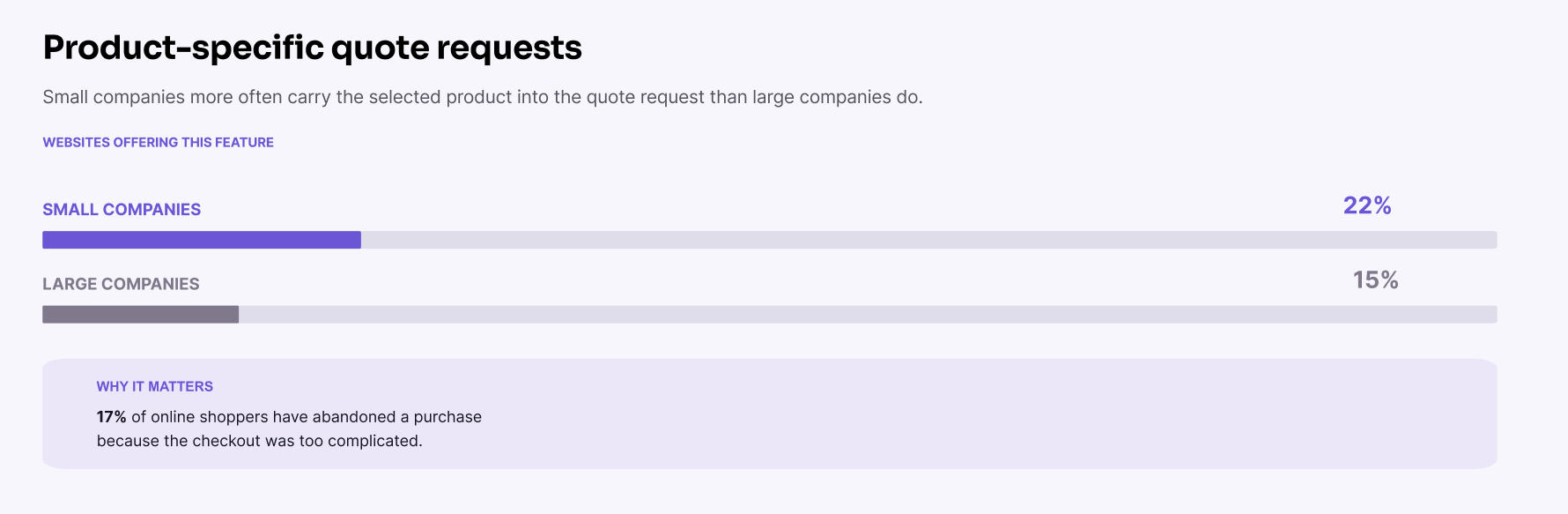
Quote requests that retain the selected product
22%
15%
At least one expected industry certification displayed
88%
80%
Source: IT Monks benchmark of 79 U.S. manufacturer websites.
A product-specific quote request keeps the product or part the buyer selected, rather than sending that buyer to a generic contact form. Visible certifications mean buyers can find relevant credentials on the website itself. The benchmark measured that visibility; it did not independently confirm any company’s certification status.
Small companies led by 7 percentage points on product-specific quote requests and by 8 percentage points on visible certifications. Keeping the selected product stayed uncommon in both groups: under a quarter of small-company websites and under one in six large-company websites did it. The overall website score gives small companies a smaller, still modest lead: 64.5/100 against 62.1/100 for large companies.
The comparison comes from a non-random benchmark. Company size follows the industry-specific thresholds set by the U.S. Small Business Administration, and the scoring weights and full method are set out in the manufacturer website research. The quoting lead matters at one moment: when a buyer has chosen a product and asks for a price.
Product-specific quote forms help buyers move from research to an enquiry
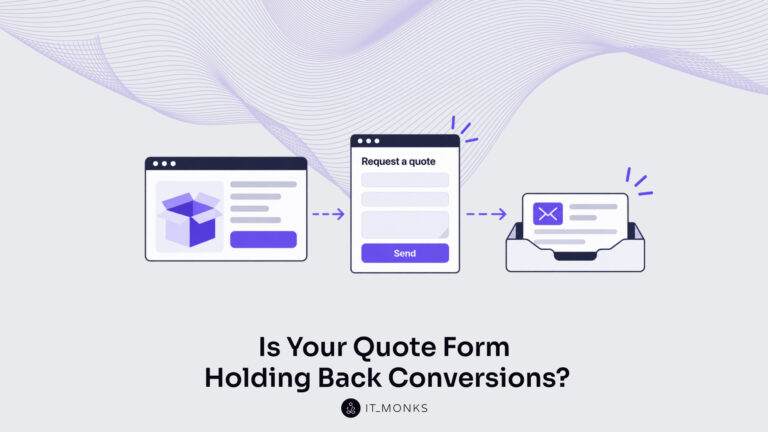
A product-specific quote form is a request form that opens with the product a buyer has already chosen. Picture an engineer who has compared three valve series and settled on one. She clicks “Request a quote.” On many manufacturer websites, that click leads to a general contact form, and the product has to be identified all over again.
A buyer reaches a quote request from the product page by one of two routes:
Generic route: product page → contact form → the buyer types the product name and requirements by hand.
Product-specific route: product page → quote form with the product details already included → the buyer adds the remaining requirements.
On the second route, the move from research to an enquiry starts with the product already in place, so the buyer can concentrate on quantity, tolerances, delivery dates and anything else the quotation depends on.
Four implementation choices decide how useful the quote form is:
Retain the product name, part number and selected options.
Ask only for the information needed to qualify or prepare the quote.
Allow drawings or specifications to be attached to the quote request where relevant.
Explain what happens after submission and when a response can be expected.
Two practical gains follow: buyers repeat less work, and the sales team receives each enquiry with the product context attached, which can cut the back-and-forth before a quote. These are reasons to build the feature, not conversion improvements measured in the manufacturer benchmark.
Form friction does have a documented cost in a neighboring field: 17% of surveyed online shoppers had abandoned a purchase because the checkout was too long or complicated, according to Baymard Institute’s 2024 article on how to minimize form fields in checkout.
That figure comes from e-commerce checkouts, not industrial quote requests; it illustrates form friction, not a quote-form abandonment rate for manufacturers. Before a quote request makes sense, a buyer needs to settle a more basic point: whether the supplier qualifies at all.
Visible certifications help buyers assess whether a supplier meets their requirements
Visible certifications are quality and industry credentials that a prospective customer can find on a manufacturer’s website. They help buyers assess whether a supplier meets their requirements before anyone invests time in an enquiry.
An aerospace buyer may need AS9100 from a machining partner. Someone sourcing general industrial components might treat ISO 9001 as the baseline. Which credentials matter depends on the industry and the part, so no single list applies to every manufacturer.
Holding a credential and making it accessible are two separate things. A company can pass every audit and still leave buyers guessing if the certificate is placed only in an unlabeled PDF or is missing from the website.
Quality certifications count early in supplier evaluation. They rank among the four leading considerations industrial buyers use when shortlisting suppliers, according to Thomas’s 2021 survey of more than 400 buyers on what industrial buyers care about most. A credential that shapes the shortlist belongs on the pages buyers already read while they compare suppliers.
Five practical steps make certifications visible and easy for buyers to find:
Provide a clearly labeled quality or certifications page.
Link relevant credentials from product and capabilities pages.
Offer readable, current certificate documents.
Make each certificate’s scope and applicable location clear, since one certificate may cover a single plant or process and not another.
Distinguish formal certification from a statement that the company follows a standard. “Built to ISO 9001 principles” and an ISO 9001 certificate are different claims.
A displayed certificate does not prove product quality or guarantee a sale. What it does is answer a qualifying question quickly, so the buyer can decide whether a conversation with the supplier’s team is worth starting.
Where large manufacturers lead: showing the people behind the company
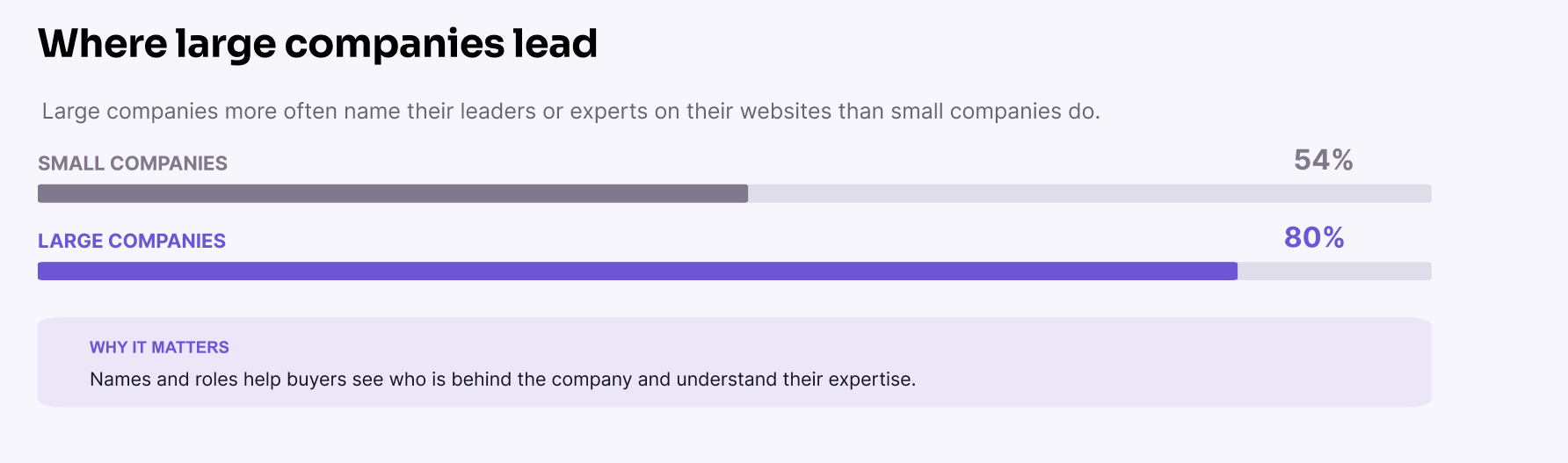
The comparison reverses on people: 80% of large-company websites identified people by name, compared with 54% of small-company websites, a gap of 26 percentage points. For small manufacturers, the benchmark results on named people mark a clear next step: making their own specialists’ expertise visible.
A website can name people in three useful roles. Leaders on an About page show who is accountable. Technical experts, such as application engineers or quality managers, show who a buyer might work with on a difficult part. Authors of articles and guides show who explains the products, and together the three roles show how the organization works.
Naming someone and showing what that person knows are different things. A name with only a job title confirms that a person exists. Add a relevant role, years of experience, and a concrete contribution to the company’s work, and the same entry tells a buyer why that person matters to a project. The 80% figure measures whether people are named on the website, not how much expertise each named profile describes.
Why small manufacturers should make their expertise visible
Small manufacturers should make their expertise visible because, when a smaller company’s specialist knowledge is held by a few people, a website that never names them leaves out part of the offer. The engineer who solves hard tolerance problems, or the quality manager who built the inspection process, may be a large part of why customers stay. A site with only products and a contact form shows neither person, and showing them gives a prospective customer more to go on when evaluating the supplier.
Small manufacturers can make that expertise visible in four practical ways:
Short profiles of technical and customer-facing specialists, from application engineers to project coordinators.
The responsibilities, relevant experience, and qualifications of each person.
Expert bylines or reviewer credits on technical articles.
Named contributors on project stories and case studies, with what each person did.
Real people and specific experience make these pages useful; “our passionate team” adds words, not information.
Affiliation with technical experts and industry scored 3.5 on a 1-to-5 credibility scale in the 2025 State of Marketing to Engineers report from GlobalSpec and TREW Marketing, based on 792 respondents. The score supports making expertise easier to find on a manufacturer’s website; it does not show that team pages or photographs increase conversions.
What manufacturers of every size can improve next?
Manufacturers of every size can improve the website features where their group trailed in the comparison:
Large companies: Review the path from product selection to quote request, and make quality credentials easy to locate.
Small companies: Make the team and its relevant expertise visible.
These are priorities the comparison suggests, not fixes reserved for one company size.
Real manufacturer website examples make both priorities easier to plan. Our ranking of the best manufacturer websites weighs website functionality and buyer needs, which makes its sites useful points of comparison.
IT Monks develops manufacturing websites with product catalogs buyers can search, quote workflows that keep the selected product attached to the request, and integrations that pass enquiries into the business systems a sales team already uses. More on that work is on our manufacturing website development page.
Explore our best manufacturer website examples, then talk to IT Monks about making product information, the quote process, and team expertise easier for buyers to access.




 ChatGPT
  Claude
  Grok
Grok  Gemini